What Two Decades of England Goalkeepers Tell Us About Talent Identification, Relative Age Effect and the Role of Regional Academies
When England named their squad for the 2026 FIFA World Cup, three goalkeepers were selected: Jordan Pickford, Dean Henderson and James Trafford.
On the surface, there was nothing particularly unusual about that.
Pickford has been England’s established number one for almost a decade. Henderson has long been viewed as one of the country’s leading goalkeepers. Trafford is widely regarded as one of the most promising young goalkeepers in Europe.
Yet when I looked more closely at their development journeys, something caught my attention.
Dean Henderson did not begin his academy career at Manchester United.
James Trafford did not begin his academy career at Manchester City.
Both began at Carlisle United.
That observation led me to a simple question:
Who really finds England’s goalkeepers?
Initially, I thought I might be uncovering a story about smaller clubs identifying talent that larger academies had missed.
The more I explored the issue, however, the more I realised the reality was far more interesting.
What emerged was not simply a story about Carlisle United, Manchester United or Manchester City.
It was a story about geography.
It was a story about development.
And perhaps most importantly, it was a story about timing.
Because when I examined England’s recent goalkeepers, one finding kept reappearing.
Many were not recruited into elite academy environments until well after the Foundation Phase.
Looking Back at Two Decades of England Goalkeepers
I reviewed every goalkeeper capped by England’s senior men’s team since 2006.
The cohort includes David James, Paul Robinson, Robert Green, Chris Kirkland, Ben Foster, Joe Hart, Fraser Forster, Scott Carson, Jack Butland, Tom Heaton, Jordan Pickford, Nick Pope, Sam Johnstone, Aaron Ramsdale, Dean Henderson and James Trafford.
At first, the geography stood out.
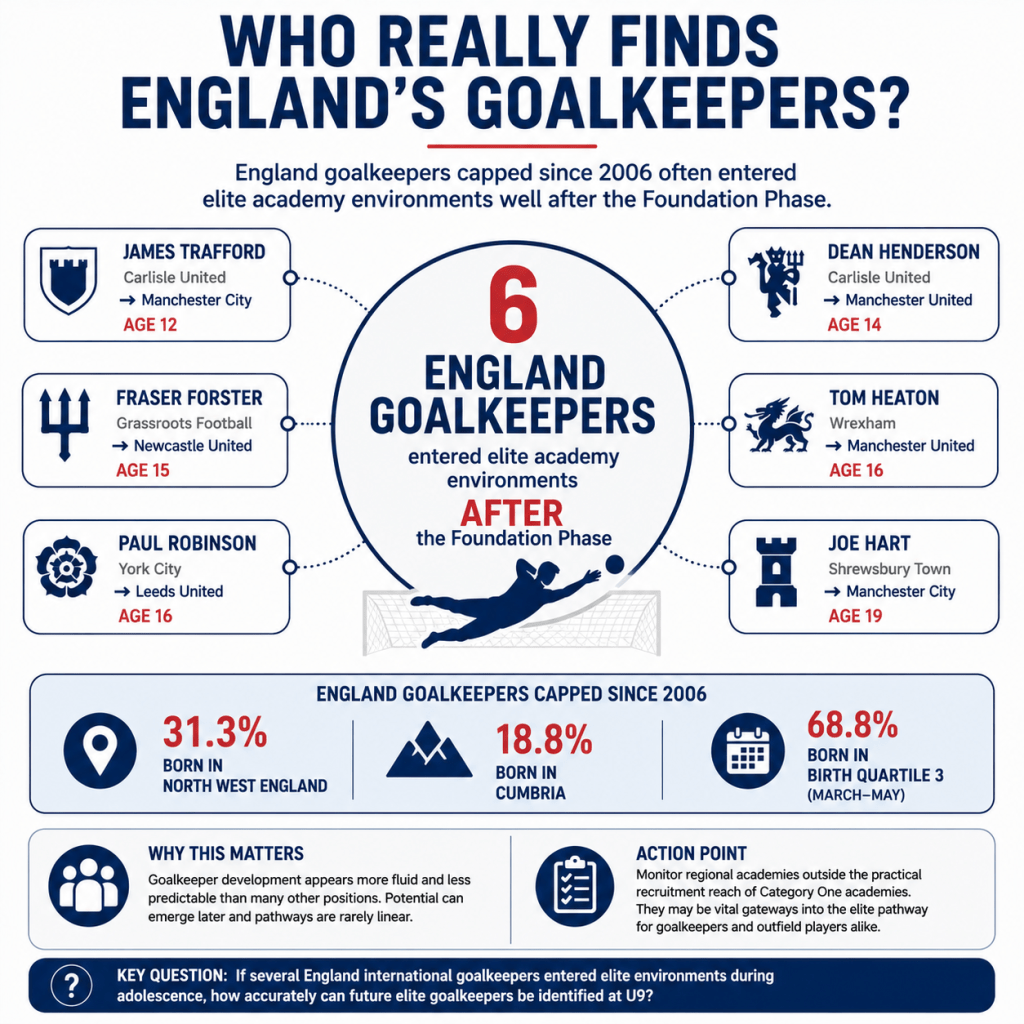
Of the sixteen goalkeepers capped by England during this period:
- Five were born in the North West (31.3%).
- Three were born in Cumbria alone (18.8%).
- Seven were born in either the North West or North East (43.8%).
Most strikingly, three England goalkeepers emerged from Cumbria despite the county accounting for only a small fraction of England’s population.
Yet birthplace only tells part of the story.
What interested me more were the development journeys.
The Later Recruitment Pattern
Much academy discussion focuses on recruitment at Under-9.
Indeed, significant resources are devoted to identifying players at the earliest possible age.
Yet several England goalkeepers followed a different route.
| Goalkeeper | Early Development Environment | Move to Larger Academy / Club | Approximate Age |
| James Trafford | Carlisle United | Manchester City | 12 |
| Dean Henderson | Carlisle United | Manchester United | 14 |
| Fraser Forster | Grassroots football | Newcastle United | 15 |
| Tom Heaton | Wrexham | Manchester United | 16 |
| Paul Robinson | York City | Leeds United | 16 |
| Joe Hart | Shrewsbury Town | Manchester City | 19 |
Each pathway is different.
Yet they all raise a similar question.
If these players ultimately became England internationals, why were several of them not recruited into elite academy environments at nine years old?
The answer may tell us something important about goalkeeper development.
The Goalkeeper Problem
Goalkeeper development presents a challenge that differs significantly from most outfield positions.
At Foundation Phase ages, many of the characteristics that ultimately define elite senior goalkeepers are difficult to assess reliably.
Height develops at different rates.
Physical maturity varies significantly.
Confidence, resilience, communication skills and decision-making often emerge much later.
Some young goalkeepers dominate because they are physically ahead of their peers.
Others are overlooked because they are physically behind them.
Unlike outfield players, where technical ability and athleticism can often be identified relatively early, goalkeeper development appears less predictable.
Fraser Forster provides an interesting example.
He did not enter Newcastle United’s academy until around the age of fifteen.
Similarly, Tom Heaton joined Manchester United at sixteen.
Paul Robinson joined Leeds United at sixteen.
Joe Hart joined Manchester City at nineteen.
These are not isolated examples.
Collectively, they suggest that elite goalkeeper potential may continue to emerge well beyond the ages at which many academy recruitment decisions are made.
Two Goalkeepers, Sixteen Decisions
One factor that receives surprisingly little attention is the simple mathematics of academy recruitment.
A typical academy squad at Under-9 may recruit around sixteen players.
Only two of those places are likely to be allocated to goalkeepers.
That creates a unique challenge.
Recruiters are effectively making long-term predictions about what may be the most difficult position in football to predict.
At eight years old they are attempting to assess:
- Future height.
- Physical development.
- Athletic potential.
- Technical capability.
- Confidence.
- Decision-making.
- Psychological resilience.
Unlike outfield positions, there is very little margin for error.
There are only two goalkeeper places available.
A club can afford to make multiple adjustments within an outfield group.
The same flexibility rarely exists with goalkeepers.
This raises an important question.
How confident can we really be in identifying future elite goalkeepers at entry age?
The journeys of Trafford, Henderson, Forster, Heaton, Robinson and Hart suggest that the answer may be less straightforward than many assume.
The Relative Age Question
This becomes even more interesting when viewed through the lens of Relative Age Effect (RAE).
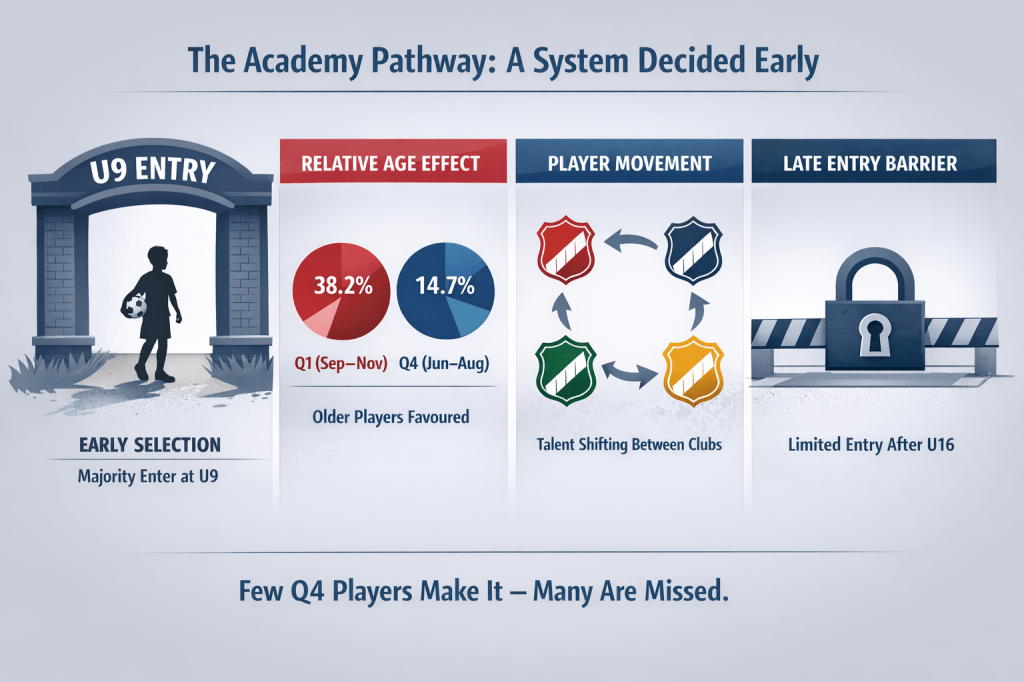
For many years, academy football has recognised the overrepresentation of relatively older players within an age group.
Numerous studies have demonstrated that players born in the months immediately following the annual age-group cut-off date are disproportionately represented within academy systems.
The reasons are well understood.
Older children within an age group often enjoy physical, cognitive and social advantages over their younger peers. Those advantages can influence recruitment decisions, particularly during the Foundation Phase.
However, caution is required when applying those findings to goalkeepers.
Most Relative Age Effect research examines academy populations as a whole.
Those populations are overwhelmingly dominated by outfield players.
Goalkeepers represent only a small proportion of the sample.
In other words, we know a great deal about Relative Age Effect within academy football generally.
We know far less about Relative Age Effect within goalkeeper recruitment specifically.
That distinction matters.
When I reviewed the birth quartiles of England goalkeepers capped since 2006, I found something unexpected.
Using the traditional academy quartiles:
- Q1: September-November
- Q2: December-February
- Q3: March-May
- Q4: June-August
The cohort was distributed as follows:
| Quartile | Goalkeepers | Percentage |
| Q1 | 3 | 18.8% |
| Q2 | 1 | 6.3% |
| Q3 | 11 | 68.8% |
| Q4 | 1 | 6.3% |
The overwhelming majority of England’s recent goalkeepers were born in the third birth quartile.
That finding does not prove anything in isolation.
The sample size is relatively small and should be treated cautiously.
Importantly, we do not know whether academy goalkeeper recruitment follows a similar pattern or mirrors the broader academy population.
Indeed, one possible explanation is that goalkeeper recruitment follows the same pattern as outfield players during the early stages of the academy pathway, with relatively older players overrepresented at entry age.
However, goalkeeper development may be sufficiently fluid that significant change occurs later through release, retention and recruitment decisions.
If so, the birth quartile profile observed at senior international level may differ significantly from that seen at academy entry.
At present, however, goalkeeper-specific data is limited and the extent to which this occurs remains unclear.
Perhaps the most important conclusion is not what the data tells us, but what it does not.
There remains a significant gap in our understanding of goalkeeper-specific development pathways.
Geography Matters
There is, however, another important factor.
Geography.
The journeys of Henderson and Trafford are often discussed as examples of Carlisle United’s ability to identify talent.
That is undoubtedly true.
However, geography also matters.
Dean Henderson grew up in Whitehaven.
James Trafford was born in Greysouthen, near Cockermouth.
Both are in West Cumbria.
Importantly, West Cumbria sits more than 100 miles from the nearest Category One academies.
Whether the destination is Newcastle, Sunderland, Manchester City or Manchester United, journey times typically exceed two hours.
For young players in the Foundation Phase, those distances matter.
Under the Elite Player Performance Plan (EPPP), recruitment during the Foundation Phase is constrained by geography and travel considerations.
As a result, regional academies become critically important.
For a talented young player growing up in Cumbria, Carlisle United is not simply another academy.
It is often the most appropriate academy.
The same principle applies across other geographically isolated regions of England and Wales.
This is why the Carlisle story is so interesting.
It may not simply be a story about identifying talent overlooked by larger clubs.
It may be a story about ensuring talented players enter and remain within the academy system long enough for their potential to emerge.
Viewed through that lens, Carlisle’s role extends beyond talent identification.
The club acts as a vital bridge between grassroots football and the elite academy system.
Without that bridge, some talented young players may never remain within the pathway long enough to fulfil their potential.
The London Question
One geographical observation stands out.
While the North West accounts for almost a third of England goalkeepers capped since 2006, London accounts for none.
That finding is particularly striking given London’s contribution to England’s outfield player pool during the same period.
Over the past two decades, London has produced a remarkable number of England internationals across outfield positions and remains one of the country’s richest footballing talent pools.
Yet none of England’s goalkeepers capped since 2006 were born there.
The reasons are unclear.
It may simply reflect the relatively small sample size involved.
However, it raises an interesting question.
Why does England’s largest population centre appear to produce so many elite outfield players but so few elite goalkeepers?
At present, there are more questions than answers.
Yet it serves as another reminder that goalkeeper development may follow pathways that differ from those of outfield players.
An Under-Researched Position?
One of the most interesting conclusions from this exercise is not what we know, but what we do not know.
Goalkeepers occupy arguably the most specialised position in football.
They are recruited in very small numbers.
Their development pathways appear less predictable.
Physical maturation may play a different role.
Psychological characteristics may carry greater significance.
Yet much of the existing talent identification and Relative Age Effect research treats goalkeepers as part of a wider player population.
Perhaps they deserve to be studied separately.
There may be a compelling case for the Premier League and EFL to examine goalkeeper recruitment and development independently.
Questions such as:
- What are the birth quartiles of academy goalkeepers?
- At what age are future elite goalkeepers typically identified?
- How often are goalkeepers recruited into elite academies after the Foundation Phase?
- How many England youth international goalkeepers followed non-linear pathways?
- How frequently are academy goalkeepers released and replaced through later recruitment?
remain largely unanswered.
Conclusions
When I started this exercise, I thought I was exploring a question about where England’s goalkeepers come from.
What I discovered was something much broader.
The evidence does not suggest that elite academies are failing to identify talent.
Nor does it suggest that regional academies are outperforming them.
Instead, it suggests that goalkeeper development may be inherently more fluid, less predictable and more dependent upon individual circumstances than many other positions.
Some future England goalkeepers are clearly identified early.
Others appear to emerge later.
Some remain within elite environments throughout their development.
Others progress through regional academies, grassroots football or professional pathways before eventually reaching the highest level.
What unites them is not a common route.
It is the absence of one.
Perhaps that is the most important lesson of all.
Potential can often be identified.
Realising that potential is far more complex.
The challenge for football is not simply identifying talented young players.
It is creating the conditions that allow that talent to flourish.
One practical implication is the importance of monitoring regional academies situated beyond the practical recruitment reach of nearby Category One clubs. If future elite players are more likely to begin their journey in these environments because of geographical constraints, understanding the quality of coaching, development and talent identification within such academies becomes strategically important for the wider game.
At the same time, the journeys of England’s recent goalkeepers suggest that recruitment and re-recruitment remain active well beyond the Foundation Phase.
Understanding how players move through that system — particularly goalkeepers — may be one of the most important unanswered questions in academy football.
And in that respect, regional academies may play a far more important role than they are often given credit for.







 Site Title