Perhaps Success Should Be Measured Not Only by the Professionals We Produce, But by the People We Develop
How should academy football define success?
It is a simple question.
Yet I suspect the answer is far more complicated than we often acknowledge.
Most clubs understandably view success through a particular lens.
Professional contracts.
First-team appearances.
International recognition.
Transfer fees.
Academy productivity rankings.
These things matter.
Indeed, they should matter.
Academies exist to identify, develop and produce elite players. That is their purpose.
But I increasingly wonder whether those measures alone tell the full story.
Because while clubs may measure success one way, children and families may measure it very differently.
And perhaps they should.
The Binary Trap
Much discussion around academy football implicitly divides children into two groups.
Those who “make it”.
And those who don’t.
Those who sign professional contracts.
And those who are released.
Success and failure.
Yet reality is rarely that straightforward.
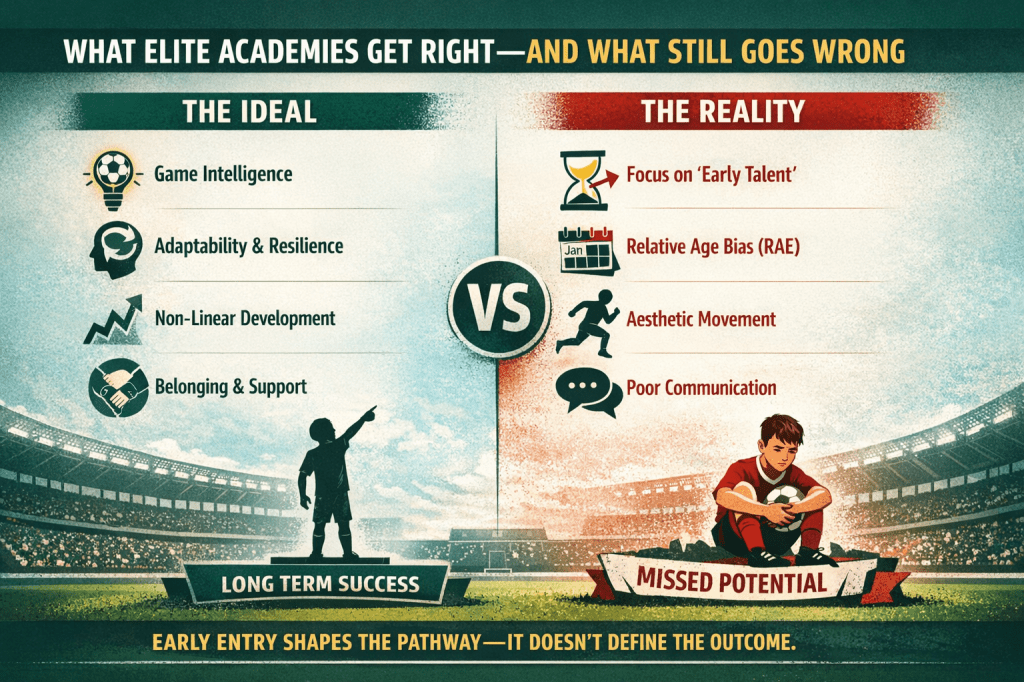
The overwhelming majority of children entering academy football at Under-9 will not go on to become professional footballers.
That is not pessimism.
It is simply the reality of elite sport.
Potential does not always realise itself as predicted.
Physical maturation.
Injuries.
Opportunity.
Confidence.
Motivation.
Luck.
Life circumstances.
And countless other factors beyond anyone’s control can influence the journey.
Not every talented nine-year-old becomes a professional.
And not every professional looked exceptional at nine.
That is the nature of development.
Looking at every child who leaves the pathway before the Professional Development Phase as some form of failure fundamentally misunderstands what academy football should be about.
The Club’s Perspective
From the club’s perspective, success is often measured through outcomes.
How many professionals were produced?
How many first-team appearances?
How many internationals?
How much transfer income?
How many academy graduates feature in the senior squad?
These are entirely legitimate measures.
After all, academies are an investment.
Clubs have a responsibility to produce footballers.
But these metrics inevitably reflect success from the perspective of the organisation.
Children and families may see things rather differently.
The Family’s Perspective
Ask a child twenty years later about their academy experience and they are unlikely to talk about academy productivity rankings.
They are more likely to remember:
Friendships.
Memories.
Experiences.
Belonging.
Confidence.
The coach who believed in them.
The teammate who became a lifelong friend.
The first time they travelled abroad.
The pride of wearing the club badge.
The excitement of playing in front of family.
The lessons they learned.
The resilience they developed.
The opportunities they experienced.
And perhaps most importantly, the feeling that they mattered.
Those things are not consolation prizes.
They are outcomes in their own right.
Belonging Matters
I have written previously about belonging and emotional resonance.
Increasingly, I believe these ideas sit at the heart of player development.
People perform best when they feel they belong.
Children are no different.
Belonging creates confidence.
Confidence encourages learning.
Learning promotes development.
Development creates opportunity.
And opportunity creates possibility.
The best environments are not necessarily those that simply produce the most professionals.
They are the environments where children feel valued, supported and understood.
Because people rarely remember every session.
They remember how people made them feel.
Years later, they may forget the scorelines.
But they will remember whether they enjoyed the journey.
Emotional Resonance
Long after tactical practices and tournament results have been forgotten, emotional resonance remains.
Children remember whether they were listened to.
They remember whether someone believed in them.
They remember whether they felt included.
They remember whether they felt safe.
They remember whether they enjoyed turning up.
They remember whether they were treated with dignity and respect.
And they remember whether they left feeling better than when they arrived.
Those memories last.
Indeed, they often outlast football itself.
That is why emotional resonance matters.
Because football memories are rarely built around exercises and practices.
They are built around relationships.
Stewardship
Increasingly, I think academy football should view itself through the lens of stewardship.
Perhaps we are not simply developing footballers.
Perhaps we are temporarily entrusted with young people and the responsibility that comes with that.
Professional contracts are one outcome.
But they are not the only outcome.
And they are certainly not the only measure of success.
Stewardship means recognising that every child matters.
Not just the most talented.
Not just the ones likely to sign scholarships.
Not just the future internationals.
All of them.
Because every child deserves a positive experience.
Every child deserves opportunities.
Every child deserves encouragement.
Every child deserves to feel they belong.
Leaving People Better Than You Found Them
One philosophy has increasingly shaped my own thinking:
Leave people better than you found them.
It is simple.
But it is powerful.
Applied to academy football, it changes the conversation entirely.
Because success is no longer reserved exclusively for those who become professionals.
Success becomes broader.
If a child leaves an academy having:
- become a better person;
- gained confidence;
- developed resilience;
- made lifelong friendships;
- experienced things they otherwise never would have experienced;
- learned important life lessons;
- and retained a lifelong love of football;
then surely that represents success.
Those outcomes matter.
Not because they are secondary to producing professionals.
But because they are valuable in themselves.
Success Is Not Binary
At my own club, many players released along the pathway secure opportunities elsewhere.
Levels change.
Players move between academies.
Others arrive from lower category clubs.
Development is fluid.
And for those who ultimately return to grassroots football, I do not view that as failure.
Far from it.
If we have given them opportunities.
If we have created positive memories.
If we have helped them grow.
If we have made them better people.
Then that should be celebrated.
Football should enrich lives.
Not merely produce footballers.
Producing Good People
Producing professional footballers is extraordinary.
It should always be celebrated.
But producing good people matters just as much.
Perhaps more.
Because only a small number of children will become professional players.
But every child will become an adult.
Every child will become somebody’s partner.
Somebody’s friend.
Somebody’s colleague.
Perhaps one day somebody’s parent.
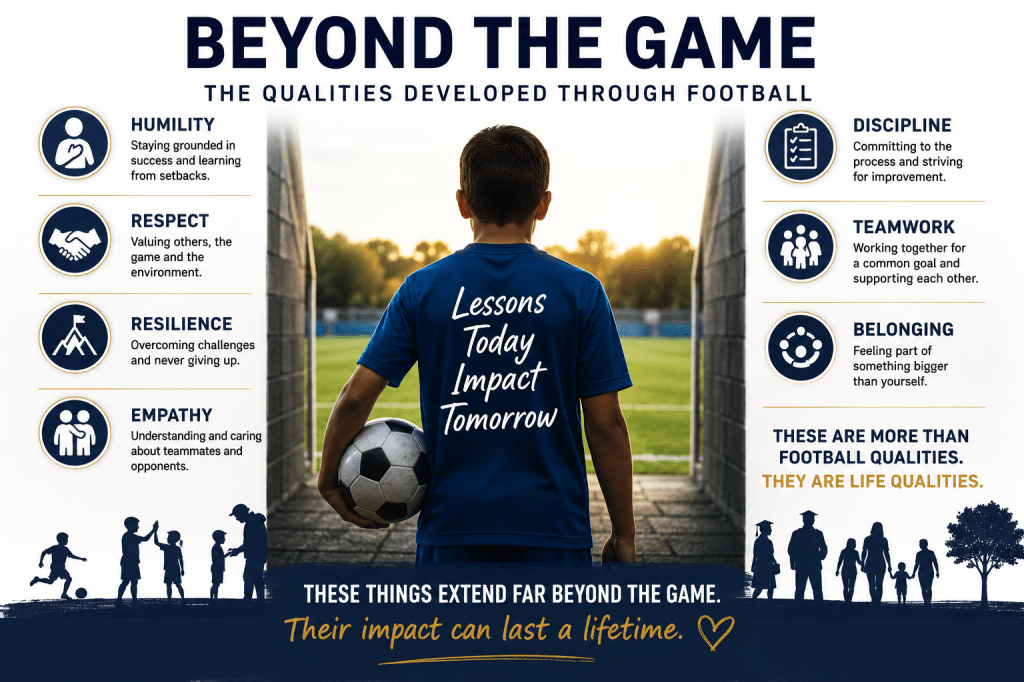
The qualities developed through football:
Humility.
Respect.
Resilience.
Empathy.
Discipline.
Teamwork.
Belonging.
These things extend far beyond the game.
Their impact can last a lifetime.
A Different Definition of Success
Maybe academy football should ultimately be judged not only by the professionals it produces.
But by the people it develops.
Because producing professionals is extraordinary.
Producing internationals is remarkable.
Generating transfer fees is valuable.
But leaving young people better than we found them may be the most important contribution of all.
Perhaps that is the true purpose of academy football.
Not simply creating better footballers.
But creating better people.
And if children leave the journey with confidence, friendships, unforgettable memories and a lifelong love of the game, then that should never be viewed as failure.
Those things are not consolation prizes.
They are success.
Perhaps success in academy football is not simply about creating professionals.
Perhaps success is about stewardship.
Perhaps success is about belonging.
Perhaps success is about emotional resonance.
Perhaps success is about opportunities.
And perhaps, above all else, success is about leaving people better than you found them.