The journey to a Premier League debut is typically framed as the product of long-term development, elite coaching, and structured academy pathways.
But when you examine the data tracking Premier League debutants, a different and more uncomfortable picture emerges.
This is not a story about gradual progression through a system.
It is a story about early selection, structural bias, and the reality that most of the defining decisions are made before a player ever signs at U9.
The Illusion of U9 as the Starting Point
One statistic stands out immediately:
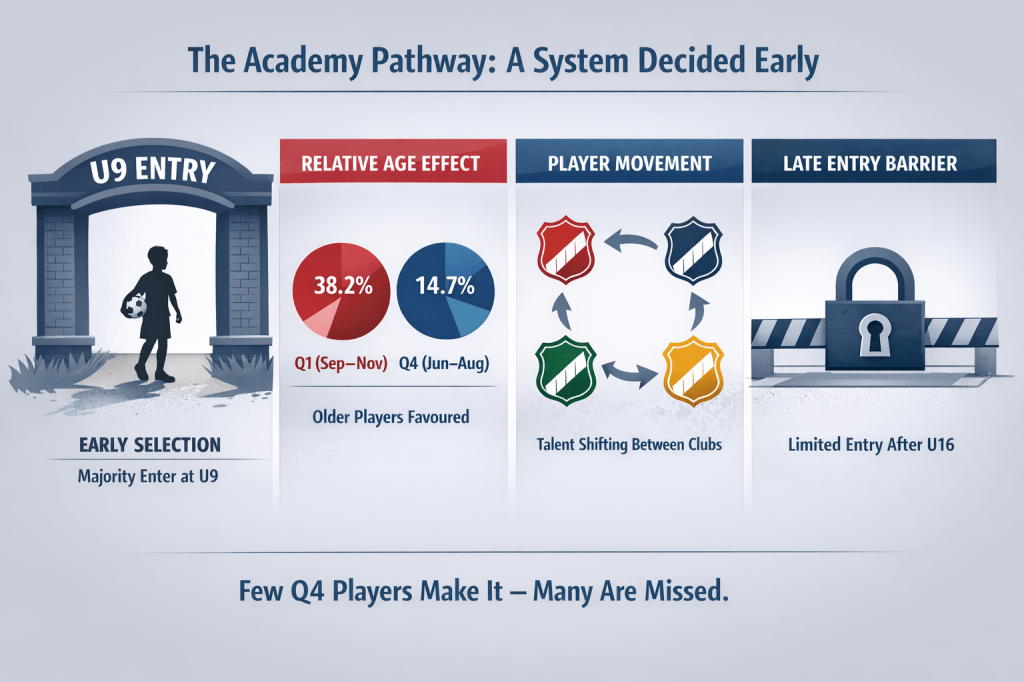
Circa 60% of eventual Premier League debutants were signed at U9
On the surface, this reinforces the importance of pre-academy recruitment at the formal entry point. But this interpretation misses the deeper truth.
U9 is not where the journey begins.
It is where decisions that have already been made are formalised.
By the point of signing:
- Players have often been observed for 12–36 months
- They have already been filtered through pre-academy environments
- Clubs have formed settled views on their trajectory
In reality:
The true selection point sits at U6–U8 — not U9.
Pre-academies are therefore not peripheral. They are:
The de facto gateway into the elite pathway.
Selection or Projection? The Relative Age Effect
Alongside early entry sits another powerful indicator:
Around 38% of debutants are born in Q1 (September–November), compared to just 15% in Q4 (June–August)
This is not marginal. It is structural.
At eight years old, a near 12-month age difference translates directly into:
- Physical dominance
- Greater coordination
- Increased confidence
- Higher perceived impact on games
Which raises a fundamental question:
Are academies selecting potential or simply selecting those who perform best at that moment in time?
At this stage, it is extremely difficult to separate:
- technical ability
- game intelligence
- psychological traits
from physical maturity.
The result is that selection, however well-intentioned, is heavily influenced by:
observable performance in the present moment
rather than long-term potential.
A Front-Loaded System with Limited Re-Entry
The data also shows:
- Nearly 80% of players are captured within the Foundation Phase (U9–U12)
- Only about 9% enter the system at U16 or later
This is often interpreted as evidence that “late bloomers are rare”.
A more accurate interpretation is:
The system offers limited opportunity for late entry once early decisions have been made.
After U12:
- visibility reduces
- opportunities narrow
- pathways become harder to access
- focuses switch to national recruitment acquisitions and is costly
The system becomes:
front-loaded and difficult to penetrate later
Movement as Correction and Consolidation
A more revealing statistics is that:
Nearly 40% of debutants moved clubs during their development
This is not incidental. It is structural.
It shows that:
- early identification is imperfect
- development is non-linear
- different environments unlock different trajectories
But it also reflects something else:
A secondary market in talent, where the strongest academies re-acquire players at older ages often from elsewhere in the system.
In practice, this means players initially developed:
- within lower-category academies
- or outside the very top tier
…are later identified and recruited by Category 1 clubs once:
- physical development has evened out
- performance is more reliable
- long-term potential is clearer
This creates a second layer of selection one based on better information than was available at U9.
However, this correction mechanism comes at a cost.
Movement between Category 1 academies, in particular, represents a resource-intensive way of correcting early decisions both financially and developmentally.
Clubs invest heavily in:
- early identification
- coaching
- infrastructure
- player development
Only for that value to be:
- lost, transferred, or duplicated elsewhere in the system
More fundamentally, it reveals a deeper structural truth:
The system does not correct itself through late entry it corrects itself through redistribution of those already inside it.
For players within the academy system, there is still a pathway through movement.
For those missed at U9, there is not.
From Talent Identification to Talent Acquisition
Given geographic restrictions and overlapping catchment areas, talented players at U8 are rarely identified by a single club.
They are identified by several.
Which reframes recruitment entirely.
This is not simply talent identification.
It is:
talent acquisition in a competitive market
By the time U9 decisions are made, players and parents are making choices.
And in that context, one factor becomes decisive:
belonging
Belonging: The Hidden Competitive Advantage
At this stage, belonging is not an abstract cultural concept.
It is immediate and practical:
- Does the child feel comfortable and confident?
- Do parents trust the environment and communication?
- Is there clarity and consistency in delivery?
- Does the player begin to feel, instinctively, “this is my club”?
Because the reality is clear:
If circa 60% of future Premier League players enter at U9, then winning that decision is not just recruitment it is securing long-term position within a closed system.
Miss at U9, and the likelihood of re-engagement later is low.
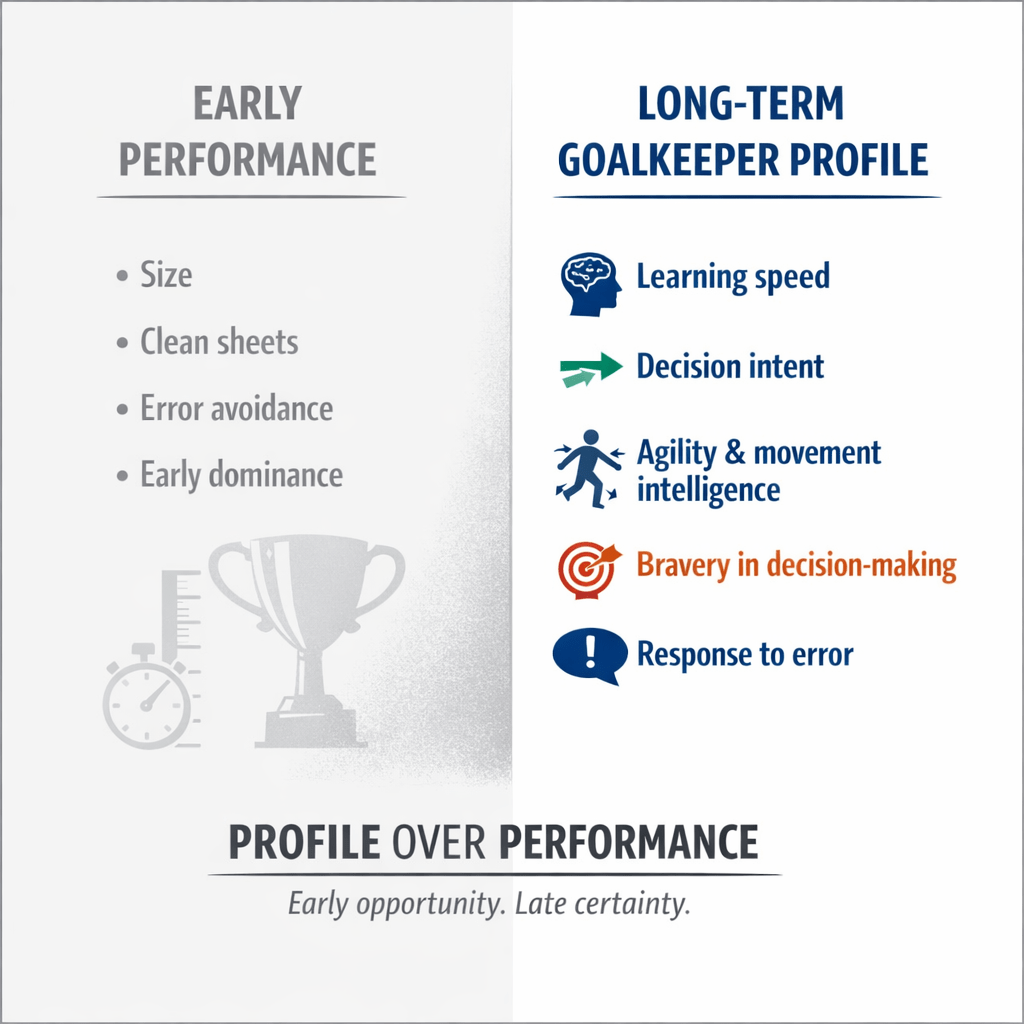
The Structural Choice: Potential or Performance
Taken together, the data presents a fundamental tension.
If:
- selection happens early
- entry later is rare
then:
the system must decide whether it is selecting for potential or performance
Because it cannot do both effectively.
Select on performance:
- you favour early maturers
- you increase error rates
- you create high churn and release
Select on potential:
- you accept uncertainty
- you require patience and better development environments
- you reduce the need for correction later
Which leads to a simple but unavoidable conclusion:
In an early-selection, closed-entry system, potential must trump performance otherwise high release rates are not a flaw, but an inevitability.
The Missing Half of the Story
There is, however, a critical limitation in the data.
It tracks those who made it.
It tells us nothing about those who did not.
We do not see:
- how many players were selected at U9
- how many were released
- how birth quarter influenced selection pools
- how many players were never identified at all
In other words:
We are looking at the end of the funnel not the funnel itself.
The Question We Should Be Asking
Which leads to the most important question of all:
How many Q4 players are missed at the end of U8, not signed at U9, and fall away from the system entirely?
Because once we accept:
- early selection
- limited late entry
…then:
missing a player at U9 is not a delay — it is often a permanent exclusion
And those players:
- are never tracked
- never developed in elite environments
- never re-enter the system
A Final Reflection
There is no question that academy systems produce elite players.
But this data suggests something more nuanced and more challenging.
The system does not simply develop talent. It defines it early.
And until we understand not just who progresses, but who is lost along the way:
we are evaluating success without understanding exclusion.