Blog

  • JJ Gabriel and the Clocks That Do Not Agree

    What one 15-year-old’s request to leave Manchester United reveals about belonging, opportunity and the competing timescales of academy development

    On Thursday 10 September, JJ Gabriel made his UEFA Youth League debut for Manchester United. He played the full 90 minutes and scored a hat-trick in a 5–0 victory over Sabah.

    The Youth League is effectively an under-19 competition. Gabriel was therefore not simply continuing to excel within his own age group. At 15, he was being tested in a European competition populated largely by players two or three developmental years older than him. UEFA’s records show that United’s squad contained players aged from 16 to 19. Gabriel was its youngest starter and, on his debut, its decisive player.

    Five days later, it emerged that Gabriel and his representatives had formally asked Manchester United to cancel his academy registration.

    Tonight, Wednesday 16 September, United play Brighton & Hove Albion in the third round of the Carabao Cup. Gabriel had reportedly been expected to be involved in the senior squad. He will no longer be part of it.

    Then, on 6 October, he turns 16.

    That sequence is what makes this case so revealing. Gabriel’s request did not arrive while his pathway appeared dormant. It arrived at the precise moment that the pathway seemed to be accelerating.

    In less than four weeks, four different clocks will have struck: his European-development clock, the relationship clock between player and club, the first-team opportunity clock and the regulatory clock that changes when he turns 16.

    The easy response is to choose a side. Manchester United can point to under-18 football, under-21 exposure, first-team training, a pre-season appearance, a UEFA Youth League debut and prospective involvement against Brighton. Gabriel’s family can presumably point to whatever has led them to conclude that his development would be better served elsewhere.

    We do not yet know their reasons. That matters. Reports have referred to concerns about game time, but neither Gabriel nor his family has publicly explained the decision. There is no responsible basis for asserting broken promises, financial motivation, parental interference or an agreed destination.

    What we can examine is the developmental structure around the decision. It exposes one of academy football’s most difficult realities: an exceptional young player does not develop according to one timetable.

    The clocks governing one young player

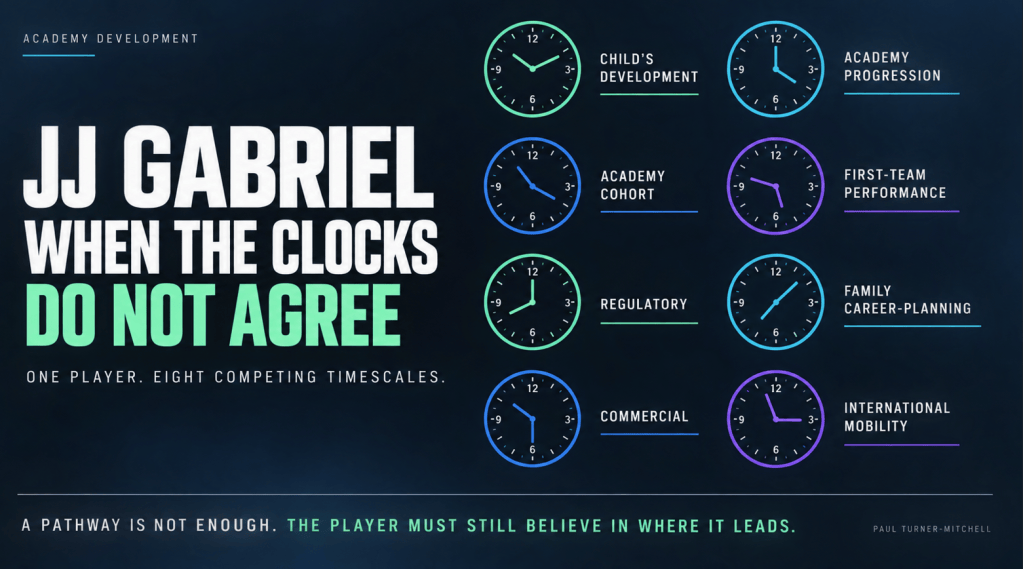
    Gabriel’s development is operating under several different clocks.

    There is the child’s developmental clock: what he needs technically, tactically, physically, cognitively, socially and emotionally at 15.

    There is the academy’s progression clock: how quickly Manchester United believes he should move through under-18, under-21 and first-team environments.

    There is the academy cohort clock: the needs of the older scholars and young professionals also waiting for more demanding football and first-team exposure.

    There is the first team’s performance clock: the immediate requirement to win matches, protect jobs and select from an internationally recruited squad of senior players.

    There is the regulatory clock: the rules governing registration, scholarship agreements, professional contracts, loans and international transfers.

    There is the family’s career-planning clock: its assessment of when progression must become tangible and whether the present club remains the best place for it.

    There is the commercial clock created by agents, sponsors, social media visibility and interest from rival clubs.

    There is now also an international-mobility clock. Gabriel’s 16th birthday may create possibilities abroad that do not exist while he is 15.

    Those clocks are not naturally aligned. The challenge for an intentional academy is not to make them all run at the same speed. It is to recognise which clock is driving each decision, make the tensions visible and prevent one of them from silently overriding the long-term development of the child.

    A pathway that was accelerating

    Manchester United appears to have been stretching Gabriel across several levels.

    He became the club’s youngest under-18 player, scored prolifically at that level and became its youngest winner of the Jimmy Murphy Young Player of the Year award. He has played under-21 football, trained with the first team and appeared for eight minutes against Atlético Madrid during pre-season.

    The Youth League debut adds an important new layer. A full match at under-19 European level is a meaningful developmental challenge for a 15-year-old. Scoring three times makes the performance exceptional, but the developmentally important fact is the environment itself: older opponents, European competition and a full 90 minutes.

    Tonight’s Brighton tie offered another potential step. Sky Sports reported that Gabriel had been expected to be involved in Michael Carrick’s squad. “Involved” does not mean that a competitive debut was guaranteed, and there is no evidence that he had been promised minutes. Squad inclusion, however, would have moved first-team proximity from presentation towards lived experience.

    The sequence complicates any simple claim that United had failed to create progression. It also illustrates the distinction between visible acceleration and sufficient certainty.

    One Youth League appearance is not a sustained programme of older football. Training with the first team is not first-team selection. Sitting on a senior bench is not playing, and one Carabao Cup opportunity does not establish when the next one will arrive.

    The academy controls preparation. The first team controls selection.

    That distinction exists at every major club. An academy can build the best possible programme, move a player into older groups and advocate for him internally. It cannot honestly guarantee competitive first-team minutes because those minutes belong to a different decision-making environment—one whose primary responsibility is results.

    Opportunity is also a cohort question

    The discussion becomes more difficult when we remember that Gabriel is not the only young player whose development requires exposure.

    Manchester United do not merely have a hypothetical group of older academy players waiting behind the first-team door. Several have already passed through it. The club’s own record of youth-team debutants shows that Harry Amass and Tyler Fredricson made senior debuts in 2025, followed during the 2025/26 season by Jack Fletcher, Shea Lacey, Bendito Mantato and Tyler Fletcher. Chido Obi, recruited from Arsenal while still academy-aged, had already made eight senior appearances by the summer of 2026. Manchester United’s official academy debutants record and this assessment of the club’s emerging 2026/27 group confirm how many players had already crossed into competitive first-team football before Gabriel’s prospective involvement against Brighton.

    They are not interchangeable. Amass and Fredricson are defenders; the Fletcher twins are midfielders; Obi is primarily a centre-forward; Lacey and Mantato offer wider attacking qualities. A first-team opening in one position cannot automatically meet the developmental need of a player in another. Yet collectively they make the cohort pressure visible. Lacey, Jack Fletcher, Tyler Fletcher, Mantato and Obi are all older than Gabriel, have already received senior minutes and remain at stages where occasional exposure must eventually become a more sustained developmental plan. Gabriel was therefore approaching a first team that already contained several young players trying to turn an initial appearance into a second, a second into a sequence and a sequence into a genuine role.

    First-team exposure is therefore a scarce developmental resource. Giving minutes to one player means not giving them to another.

    The highest-potential player is not automatically the player who most needs the next available minutes. A 15-year-old can be exceptional and still have multiple appropriate academy challenges available. An 18- or 19-year-old may have reached the point at which under-21 football no longer supplies what development requires.

    This creates a genuine stewardship question. Should a club accelerate the exceptional 15-year-old partly because it fears losing him, or use the opportunity for an older player whose developmental need is more immediate?

    There is no universal answer. Position, readiness, opposition, match context and the needs of the individual all matter. But retention pressure must not be allowed to become an invisible selection principle. Otherwise, the player most capable of leaving can begin to receive opportunities ahead of the player most in need of them.

    An intentional academy has responsibilities to individuals and to the cohort. It must be capable of explaining how it reconciles both.

    Why United cannot simply loan him out

    At 15, Gabriel cannot be loaned into senior football in the way an older professional can.

    The Premier League Handbook defines a temporary transfer—the formal mechanism used for a loan—through the transfer of a contract player’s registration. An under-17 player cannot enter a professional employment contract and remains an Academy Player. Gabriel therefore has no professional registration capable of being temporarily transferred.

    That removes one of the principal mechanisms clubs use to give young professionals sustained senior minutes. United cannot solve the tension by finding Gabriel 25 or 30 matches in the EFL while retaining control of his longer-term development.

    The limitation is not peculiar to Manchester United. It follows the player to any other English academy.

    Would another English club offer something different?

    If Gabriel joined another leading English club, he would remain an Academy Player subject to the same basic regulatory constraints. He still could not become a professional at 16 and still could not be sent on a conventional senior loan.

    His football environment could change. Another club might offer a different playing style, positional need, coaching relationship, squad composition or degree of internal confidence. It might place him more regularly with its under-21s or identify a clearer route to first-team training.

    But another elite club would face the same structural contradiction. Its first team would also be expected to win. It would also recruit world-class talent internationally. It would also have older academy players requiring exposure. Its head coach would still select according to immediate competitive judgement rather than an academy promise made during recruitment.

    The existing club is judged by lived experience. The prospective club is judged by projected intention.

    That imbalance matters whenever a young player considers leaving. The limitations of the present pathway are visible; the limitations of the proposed pathway remain hypothetical. A compelling presentation can describe what might happen. It cannot establish what will happen when form, injuries, coaching changes, recruitment and results intervene.

    Unless another club has a genuine positional opening and a credible commitment to use him, the underlying football problem may remain largely unchanged.

    Cancellation is not the same as freedom to register elsewhere

    Gabriel has reportedly asked Manchester United to cancel his academy registration. Under the Premier League Youth Development Rules, cancellation can occur by agreement between the club, player and parents. If agreement is not reached, the player or parents can apply to the Premier League Board, which can consider representations, hold an inquiry and impose conditions—including compensation-related conditions—when determining the matter.

    Cancellation at United and approval to register at another English academy are separate questions.

    Where a player with a previous academy registration seeks to join another Premier League club and compensation is payable, the League may undertake what is commonly called the Five Step Review. It is an investigative approval process intended to identify prohibited approaches or inducements before the new registration is accepted.

    The Premier League’s public guidance says the player and family may need exit interviews. The player, parents and proposed new club must declare that no prohibited approach or inducement occurred, and the League can request evidence such as telephone and banking records. The process may take several weeks, during which the player cannot train or play with the proposed academy.

    The current rules give the League discretion over the investigation; they do not publicly set out five neatly numbered procedural stages. It would therefore be too absolute to say that every domestic move automatically follows an identical five-step sequence. In Gabriel’s circumstances, a domestic registration application involving compensation would make that scrutiny highly likely.

    The process is important because academy mobility is not intended to become an unregulated contest in which clubs privately recruit registered children from one another.

    What changes when he turns 16?

    Gabriel turns 16 on 6 October, but the domestic contractual position does not transform overnight. Three separate dates need to be distinguished.

    A scholarship can be offered and accepted before he turns 16. Premier League Youth Development Rules, a club holding an Academy Player’s registration may make a scholarship offer before 31 December of his under-16 year. Gabriel could therefore already receive and accept an offer. Acceptance, however, would not make him a scholar immediately.

    He cannot become a scholar until Friday 25 June 2027. The rules provide that the Scholarship Agreement may commence no earlier than the final Friday in June of the academic year in which the player reaches 16. For Gabriel, that date is 25 June 2027—not his 16th birthday on 6 October 2026. Until then, he remains an Academy Player rather than a scholar.

    Future professional terms can be offered from 1 November 2026, but cannot take effect until 6 October 2027. The rules permit a club, from 1 November following the start of the player’s under-16 year, to offer a contract under which he becomes a Contract Player upon reaching 17. In everyday football language, Gabriel could therefore agree future professional terms from 1 November 2026. He cannot be employed and registered as a Contract Player under those terms until his 17th birthday on 6 October 2027. The operative distinction is between agreeing the future contract and becoming a professional player. These dates follow the Premier League’s 2026/27 Youth Development Rules.

    Turning 16 is more significant internationally.

    FIFA generally prohibits the international transfer of players under 18, but Article 19 contains limited exceptions. One permits transfers between the ages of 16 and 18 within the European Union or European Economic Area. FIFA’s guidance also allows a transfer from outside the EU or EEA into it where the player holds EU or EEA nationality.

    Reports state that Gabriel holds an Irish passport. If that nationality is established for the application, turning 16 could potentially allow him to move from England to a club in Spain or another EU or EEA country.

    That would not be automatic. The proposed club would need prior approval through FIFA’s process and would have to satisfy requirements concerning football development, education, accommodation, care and welfare. An International Transfer Certificate would be required. Manchester United’s registration and any compensation rights would not simply disappear.

    Nevertheless, the regulatory clock would have moved. A route unavailable at 15 could become legally possible at 16.

    Money can change before opportunity does

    A move to Spain could also change the financial position.

    Spanish law can permit a 16-year-old to enter professional employment with the necessary consent, while FIFA limits contracts involving minors to a maximum of three years. An EU club could therefore potentially offer Gabriel an operative professional contract before an English club can if the reports of an Irish passport are true.

    That creates an important distinction between certainty about future money and receiving professional money now.

    Gabriel would not have to wait until he is 17 to obtain contractual certainty in England. From 1 November 2026—less than a month after his 16th birthday and only around six weeks from the date of his request—an English club could offer terms under which he would become a Contract Player when he turns 17. Those future professional terms could therefore be agreed almost immediately. His scholarship could then begin on 25 June 2027, bringing scholarship remuneration, before the professional contract became operative on 6 October 2027.

    What England cannot provide is an operative professional contract during that intervening year. Subject to the international-transfer requirements and Spanish employment law, a move to Spain could potentially bring professional status and salary forward from October 2027 to shortly after October 2026. In broad terms, it could accelerate the financial clock by almost a full year.

    A salary appears in a contract. A pathway appears in a presentation. Only one is guaranteed.

    If certainty about future earnings is the objective, leaving England is not essential: that certainty could potentially be secured from 1 November. If receiving professional earnings immediately is the objective, an eligible move into the EU may provide something an English club cannot yet provide. If football development is the objective, the comparison is more demanding. The question is not which club can make the strongest promise. It is which environment can provide the right training, appropriate competitive stretch and a credible sequence of minutes over time.

    Money can be guaranteed by contract. Opportunity remains governed by judgement.

    A move to Spain could bring the financial clock forward by almost a year. It would not necessarily bring the developmental or first-team opportunity clock forward at all.

    Spain’s B-team structure changes the question

    Barcelona and Real Madrid are particularly interesting because Spanish reserve teams operate differently from Premier League under-21 sides.

    Their B teams play within the senior Spanish league pyramid. They face adult opponents in competitive divisions with promotion and relegation, although a reserve team cannot play in the same division as its first team and cannot participate in the Copa del Rey.

    For the current 2026/27 season, Real Madrid Castilla play in Group 2 of Primera Federación, the third tier of Spanish football. Real Madrid’s report of Castilla’s opening league fixture against Teruel on 31 August confirms both the competition and group. Barça Atlètic play one level below in Segunda Federación, the fourth tier; Barcelona’s own preseason announcement expressly identifies that as the development side’s 2026/27 competition. The placement of the two teams should therefore not be collapsed into a generic claim that both offer the same standard of reserve-team football: Castilla currently operate one division higher. Real Madrid and FC Barcelona both confirm the current-season position.

    This gives those clubs an internal route into adult senior football without first sending a player on loan. In developmental terms, that can be significant. A young player can remain inside the club’s methodology, facilities and oversight while experiencing adult physicality, consequences and competitive pressure.

    It does not guarantee Gabriel anything.

    Both B teams select to compete. Both contain other outstanding young players. Both have their own positional queues and immediate performance demands. A 16-year-old recruited by Barcelona or Real Madrid would still have to earn minutes, and senior football is not automatically better development simply because the opponents are adults.

    The Spanish structure could change the developmental problem. It would not remove the selection problem.

    What would a genuinely different opportunity look like?

    The relevant comparison is not Manchester United against the reputation of another club. It is one detailed developmental programme against another.

    A genuinely different opportunity would need to answer practical questions:

    • Which team would Gabriel train with each week?
    • Which competition would provide most of his minutes?
    • Who is currently ahead of him in his position?
    • Which older players also need those minutes?
    • What is the intended sequence from youth football to adult football?
    • Who controls movement between academy, reserve and first-team environments?
    • What happens if the first-team coach changes?
    • What education, accommodation and pastoral support would surround an international move?
    • How would the club protect development if immediate selection did not follow recruitment?

    Without convincing answers, the move may change the badge, geography and contractual value without substantially changing the developmental uncertainty.

    Belonging when the player chooses to leave

    This case also tests how we understand belonging.

    Belonging is sometimes discussed as though its purpose is retention: create attachment, deepen identification and make talented players less likely to leave. That reduces a human need to an institutional mechanism.

    Authentic belonging cannot mean: You belong here for as long as you continue to choose us.

    If Gabriel leaves, the quality of United’s stewardship will also be visible in how the club responds. Can it protect the child from adult hostility? Can it distinguish disappointment from betrayal? Can it communicate honestly without using access to brief against a 15-year-old? Can it preserve the dignity of a relationship even if that relationship is ending?

    Academy football is accustomed to clubs deciding that children will leave. This case reverses the direction of that power. The child is attempting to release the club.

    That reversal can expose whether belonging was understood as a mutual human relationship or as loyalty expected primarily from the player.

    The academy’s responsibility does not disappear because the player wants to go. Final transition remains part of the developmental experience. The emotional legacy of the pathway will be shaped not only by the years already spent at Carrington, but by how its final weeks are handled.

    The least-heard voice

    There is one voice almost entirely absent from the public discussion: Gabriel’s own.

    That does not mean a 15-year-old should be placed before cameras or required to explain a private family decision. It means those responsible for the process should be curious about what he understands, what he wants, what he fears and how much ownership he genuinely has.

    Player voice is not the same as allowing a child to carry the decision alone. Nor does listening mean that every preference must be followed. Adults remain responsible for providing context, testing assumptions and protecting long-term welfare.

    But a pathway is not credible because the academy can describe it. It becomes credible when the player can experience, understand and trust it.

    That may be the central issue here. United can identify substantial evidence of acceleration. Gabriel and his family have nevertheless reached a point at which they are prepared to interrupt it. The gap between those two realities deserves more attention than the instinct to identify a winner and a loser.

    The next few weeks

    Much remains unresolved. United may refuse to agree to immediate cancellation. The Premier League may become involved. The relationship may still be repaired. Another English club may seek to register him. A European club may wait until his 16th birthday and pursue FIFA approval. The reported interest may produce no move at all.

    Tonight’s match against Brighton will add another counterfactual. If United give meaningful minutes to another academy player, Gabriel’s possible place in the squad will become part of the discussion. If the match creates an obvious opportunity for a young attacker, the timing of his request will appear still more striking. None of that will tell us whether he would actually have played.

    The period from his Youth League debut on 10 September to his 16th birthday on 6 October offers an extraordinary case study in developmental timing.

    One clock says he is still a child.

    Another says he is already capable of dominating an under-19 European match.

    Another places him close to Manchester United’s first team.

    Another prevents him being loaned into sustained senior football.

    Another may shortly allow him to sign professionally abroad.

    Another reminds United that older academy players also need opportunities now.

    And the commercial clock tells everybody that delay carries a price.

    The temptation is to ask which club will win the contest for JJ Gabriel, or to decide in advance what must be motivating the request. The more important developmental question is different: which environment can offer the most appropriate next experience, and on what evidence should a 15-year-old and his family believe it?

    Young players do not develop according to one institutional timetable. Their development sits at the intersection of childhood, performance, regulation, family judgement, cohort responsibility, commercial value and international mobility. When those clocks cease to agree, the existence of a pathway is not enough.

    The player and family must still believe in where it leads.

    We may never know the true motivation behind Gabriel’s request. We can identify the available options. We can examine what each would change, what each would leave unchanged and which benefits can genuinely be guaranteed. We can distinguish earlier money from better development, contractual certainty from competitive opportunity, and a different pathway from a genuinely clearer one.

    But we cannot know which of those considerations is driving the decision unless Gabriel and his family eventually choose to explain it. Until then, any conclusion about motive remains speculation.

    We know what the options are. We know what they look like. Only time will tell which option is chosen—and what the choice was really intended to achieve.


    Beyond the Pathway

    The questions raised by JJ Gabriel’s situation—belonging, stewardship, clear pathways, player voice and the responsibilities that remain when a young person chooses to leave—sit at the heart of my book, Beyond the Pathway: Belonging, Human Development and the Purpose of Academy Football.

    The book asks academy football to look beyond contracts, debuts and first-team outcomes and consider the human experience created for every child who enters the pathway. It explores how clubs can cultivate belonging intentionally, exercise stewardship responsibly and judge success by the people they help to develop as well as the players they produce.

    Beyond the Pathway is available now on Amazon Kindle:

    You do not need a Kindle or any other e-reader. The book can be purchased and read immediately on a phone, tablet, laptop, PC or Mac using Amazon’s free Kindle app.
  • We Know When the Footballer Has Made It. But What About the Person?

    There are things you notice when you spend enough time around elite football that will never appear on a scouting report, performance dashboard or individual development plan.

    Through my work at Manchester City, I have been fortunate enough to spend time close to the first-team environment. I have been pitch-side at first-team games overseeing the ball teams, as well as working within the academy environment, and that has allowed me to observe from relatively close quarters things that most people understandably experience only through a television screen.

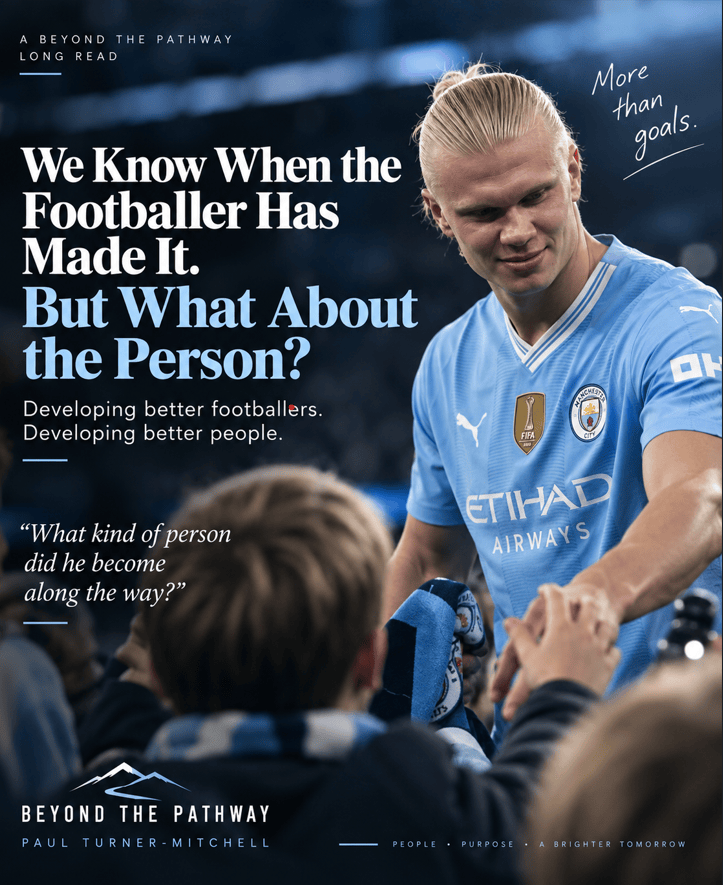
    Over time, I started noticing small things about Erling Haaland. I have watched him remove his warm-up top, fold it and hand it properly to the member of staff rather than simply throw it towards them. I have seen him help put footballs back into the bag after training. From pitch-side, I have watched the way he interacts with mascots and children around the first-team environment.

    These are not stories somebody has subsequently told me and they are not observations drawn from social-media clips. They are things I have personally witnessed. None is remarkable in isolation and perhaps that is precisely why I find them interesting. They are ordinary behaviours being demonstrated in an extraordinary environment by somebody who has reached an extraordinary level of status within it. More importantly, they are things he does not have to do.

    There was another moment that has stayed with me for a much more personal reason.

    A few years ago, I took my son into City with me while I was working. He had broken his shoulder the previous day and had only just started secondary school, so he was still a young lad. His arm was in a sling.

    Erling was on the indoor pitch finishing a photoshoot. I was waiting at the side because I needed to set up for an academy session once he had finished. When the shoot ended, he could quite easily have walked away without ever knowing we were there. Instead, he noticed my son, walked across to him and started talking to him.

    I don’t know whether Erling remembers that interaction. I suspect he doesn’t. It was probably a tiny moment in a day containing hundreds of interactions and demands on his time. My son and I remember it.

    The more I have thought about that moment alongside the other behaviours I have witnessed, the more it has taken me back to one of the fundamental ideas behind my book, Beyond the Pathway. Academy football should not simply develop better footballers. It should aspire to develop better people too.

    The difficult question is how we know whether it has.

    From Bryne to Manchester

    That question made me curious about whether what I had observed at Manchester City was simply that: a collection of unrelated moments. So I started looking backwards through Haaland’s development.

    What I found at Bryne, the small Norwegian club where much of his childhood football development took place, interested me enormously. Alf Ingve Berntsen coached Haaland through a significant period of his formative years. There were around 40 children in the group and, unlike the highly professionalised academy structures familiar to us in England, much of their early football was being delivered by volunteer parent coaches.

    Accounts from Bryne describe Haaland as a happy child who smiled a lot, trained hard and loved scoring goals. His potential was apparent, although predicting what he would eventually become would have been impossible. He was relatively small and skinny during part of that early development and regularly played with older children.

    What interests me more, however, is what Berntsen says about the purpose of their environment. He wanted all the players he coached to do well in life as much as in football, and he and the other coaches consciously tried to instil values that those boys would carry through their lives. When people subsequently asked whether he was proud of his involvement in Haaland’s early football education, his instinctive test was revealing: how had those young people turned out and how did they behave?

    There is something wonderfully uncomplicated about that philosophy.

    It would be far too simplistic to draw a straight causal line from a childhood football environment in Bryne to an adult folding his training top in Manchester many years later. Human development doesn’t work like that. Haaland will have been shaped by his parents, family, friends, coaches, teammates, clubs, cultures, successes, disappointments and countless experiences that we cannot see.

    But the continuity is worth thinking about, because we spend enormous amounts of time identifying the behaviours that might make an eight-year-old become an elite footballer. How much time do we spend intentionally developing the behaviours we would hope that same eight-year-old still demonstrates if, one day, he becomes one of the most famous footballers in the world?

    What survives the pathway?

    That question sits right at the heart of Beyond the Pathway.

    Elite academies have become extraordinarily sophisticated development environments. We identify technical, tactical, physical and psychological characteristics. We assess potential, build individual development plans, analyse performance and measure progression. Increasingly sophisticated data allows us to understand young players in ways that would have been unimaginable a generation ago.

    Those things matter. An academy exists, in part, to develop footballers. But if we also claim to develop people, where are the equivalent outcome measures?

    We know how to recognise the football outcome. A child progresses through Foundation Phase, becomes a scholar, signs professionally, plays first-team football or represents his country. At the extreme end of the spectrum, he might win major trophies, break goalscoring records and become one of the most recognisable athletes on the planet.

    The pathway has very visible markers telling us whether the football development succeeded. If we say that character, humility, respect, responsibility, empathy and belonging matter too, where are the equivalent markers telling us whether that development succeeded?

    Perhaps the more interesting question isn’t simply whether the player made it. It is what kind of person made it.

    What Guardiola noticed

    What makes Haaland an interesting case through which to explore this is that the observations are not mine alone.

    Soon after Haaland arrived at Manchester City in 2022, Pep Guardiola was asked what had impressed him about his new striker. Given the goals, physical attributes and competitive mentality Haaland had brought with him, there was plenty Guardiola could have chosen. Instead, he talked about his education and humility.

    Guardiola had particularly noticed how much Haaland spoke to the young players around the first-team environment rather than restricting his attention to the established players. He described him as an incredible competitor but said what had impressed him most was his education, his humility and his willingness to engage with those younger players.

    That is revealing because young academy players cannot do very much for Erling Haaland’s career. He doesn’t need their approval and they have no organisational power over him. Yet one of the first things his manager noticed was his willingness to engage with them.

    Guardiola returned to Haaland’s character as he got to know him better. He spoke about how quickly his personality had impressed him, describing someone who was always smiling and reflecting on the humility he had encountered among some of the biggest stars he had coached. Years later, that assessment remained remarkably consistent. After making Haaland part of City’s leadership group, Guardiola described the unusual combination of a genuinely world-class player who remained incredibly humble, thought about what was best for the team and possessed a kindness alongside his extraordinary competitive drive.

    For me, that consistency matters. It doesn’t prove anything definitive about Haaland as a person, and none of us should pretend we can know somebody’s entire character from observations around football. But when behaviours witnessed informally around the environment are consistent with what a manager working with that player every day repeatedly describes, they become worthy of consideration.

    Gratitude along the pathway

    There are glimpses of the same characteristics earlier in Haaland’s journey.

    Paco Johansen worked with him through Norway’s youth international teams. When their period together ended, Haaland took the time to write personally to Johansen and the other coaches to thank them for what they had done for him. Johansen remembers somebody who was appreciative of what he had learned, listened to advice and remained grounded despite already becoming the biggest young star in Norwegian football.

    That interests me because gratitude is another developmental behaviour that becomes more difficult to assess as somebody becomes increasingly successful. Every elite player’s journey contains people who helped when there was no guarantee of what the eventual outcome would be. Grassroots coaches, academy staff, teachers, parents, scouts, physios and countless others contribute small pieces to a development journey that may span 15 or 20 years.

    Success can make it easy to rewrite that story around the individual. Human development perhaps asks whether the player continues to recognise the people within it.

    When Haaland eventually left Borussia Dortmund for Manchester City, there was another example. He reportedly gave farewell watches not only to his teammates but also to dozens of members of the club’s staff. The monetary value inevitably generated headlines. For me, the more interesting point is that the staff were remembered too.

    Elite football depends upon enormous numbers of people whose names supporters will rarely know. Medical staff, kit staff, analysts, chefs, security staff, operations teams and countless others create the environment within which the player performs. That brings me back to the warm-up top.

    The significance isn’t really whether a piece of clothing is folded or thrown. A kit member’s job will involve dealing with it either way. The interesting thing is the relationship represented by the behaviour. Do I see somebody whose job exists to serve me, or do I see another person contributing to the environment that allows all of us to succeed?

    Those are very different ways of understanding status.

    Character under autonomy

    Academies spend considerable time assessing behaviour. Players are expected to arrive punctually, listen, work hard, demonstrate respect, respond positively to challenge and behave appropriately towards coaches and teammates. Those expectations are entirely reasonable, but there is a problem if we treat compliance with them as the completed product of character development.

    A young academy player exists within a hierarchy in which adults hold most of the power. Coaches select him. Staff assess him. Clubs decide whether he remains within the programme. Adults establish the standards and consequences. A young player may therefore behave appropriately partly because the environment requires him to.

    Elite success eventually reverses much of that hierarchy.

    Imagine the distance between the child at Bryne and the adult Erling Haaland. The child is learning how he is expected to behave within a football environment. The adult has wealth, fame, enormous professional status and millions of followers. Thousands of people want something from him. Entire commercial campaigns are built around him and members of staff exist specifically to support his performance.

    Nobody is going to remove one of the world’s greatest strikers from the team because he didn’t help put the footballs away. That is why I think status provides such an interesting test of development.

    Character under instruction is not quite the same thing as character under autonomy.

    Perhaps one of the ultimate tests of development is what somebody chooses to do when nobody needs to tell them anymore.

    Learning to notice

    Thinking again about the moment involving my son, there is another quality underneath kindness or respect that I think we sometimes overlook. Before you can demonstrate either, you first have to notice another person.

    Erling didn’t have to notice a young boy standing quietly at the side of an indoor pitch with his arm in a sling. He had finished what he was there to do. My son wasn’t waiting for an autograph or being presented to him as part of an organised engagement. He simply noticed him and then acted upon what he noticed.

    The same principle arguably sits underneath many apparently mundane interactions. To acknowledge the kit person, you first have to recognise them as more than a function. To engage properly with a mascot, you have to appreciate that the few seconds you spend with that child may carry considerably more meaning for them than they do for you. To engage with young academy players when you are an established superstar requires some awareness of what your attention might mean to them.

    Perhaps an important human-development outcome is therefore remarkably simple: do you continue to notice other people?

    What happens when it hurts?

    There is another dimension to this that became visible during the 2026 World Cup.

    Norway’s tournament had been extraordinary. Haaland scored seven times in his first four appearances as his country reached the quarter-finals, where they faced England in Miami. It ended in disappointment, with England winning 2–1 after extra time. Haaland had been kept off the scoresheet for the first time in the tournament and the conditions had taken an enormous physical toll. The heat and humidity were oppressive, he had suffered a dead leg and eventually had nothing left. Norway coach Ståle Solbakken subsequently explained that Haaland was physically finished and substituted him during extra time.

    For somebody as relentlessly competitive as Haaland, the disappointment must have been enormous. Norway’s best World Cup run was over, but what happened around that defeat interests me.

    After the final whistle, Haaland remained on the pitch for several minutes to acknowledge the Norwegian supporters. It was subsequently reported that he was the final Norway player to leave the stadium, staying behind until around 9.30pm while meeting supporters and families and taking photographs.

    Again, it is a relatively small thing, but perhaps human development is also revealed by what we do when things haven’t gone our way. It is relatively easy to acknowledge supporters while carrying a trophy. It is harder after your World Cup has just ended, your body is exhausted and all you probably want is some privacy in which to process the disappointment.

    There is also something here that connects very personally with my own experience of Haaland. A photograph or conversation with another child may occupy only a few seconds of an elite player’s life. For the child receiving that attention, those few seconds can become a lifelong memory.

    I know that because I have seen it happen. My son cannot tell you what else Erling Haaland did on the day he met him. Erling probably cannot remember the interaction at all. But my son remembers that Erling noticed him. Perhaps some of those families in Miami now have their own version of that story.

    That matters because developing the person cannot simply mean teaching appropriate behaviour when circumstances are comfortable. Football inevitably brings disappointment, rejection, injury, frustration and failure. One measure of development must therefore be how somebody responds when those emotions are at their strongest.

    How do I treat other people when I am disappointed? Can I recognise what a moment means to somebody else even when the moment is painful for me? Can I still give something of myself when personally I would rather withdraw? Those aren’t football questions. They are human ones.

    Human Development Indicators

    In Beyond the Pathway, I explored the idea of Human Development Indicators because I believe we need a broader conception of what successful development means.

    I am not suggesting academies should create a spreadsheet awarding somebody 8.7 for kindness or add another coloured box to the multidisciplinary review. Human beings are too complicated for that, and attempts to quantify character can very quickly become another selection tool masquerading as development.

    But that doesn’t mean human development cannot be considered, observed and evaluated.

    We can ask whether a player recognises the contribution of others and how they treat people with less organisational status. We can consider whether they contribute when there is nothing obvious to gain, whether they demonstrate gratitude, how they respond to another person’s vulnerability and whether they can genuinely celebrate somebody else’s success. We can observe how they accept responsibility, how they remain connected to people and communities that contributed to their development and, eventually, how they use status when they acquire it.

    Perhaps one of the most revealing questions is what somebody does when nobody is assessing them.

    The purpose of those questions, however, should not be to decide whether a child possesses the “right character”. That would simply turn human development into another Talent ID filter. The accountability should sit with us.

    Instead of asking only, does this child demonstrate the characteristics we want?, we should also ask, what is our environment doing to help this child develop those characteristics?

    That is stewardship.

    The football outcome and the human outcome

    There is an obvious danger in using Haaland as the example because he represents an almost impossibly successful football outcome. Most children entering academies will not become Premier League footballers. Some will play professionally elsewhere, some semi-professionally and many will leave the professional pathway altogether. They will become teachers, electricians, business owners, coaches, parents and volunteers at grassroots football clubs.

    That doesn’t weaken the argument. It strengthens it.

    If an academy genuinely believes that developing the person forms part of its responsibility, human development cannot be something whose value depends upon eventually producing a professional footballer. The football outcomes will vary enormously, but the human outcome applies to everybody.

    A player who leaves an academy at 16 having developed confidence, responsibility, empathy, independence, meaningful relationships and a secure sense of his own worth has not left empty-handed simply because professional football did not follow. Those things travel with him. The pathway may end, but the person continues.

    That is one of the reasons I use the language of stewardship in Beyond the Pathway. For however long a child remains within an academy, the club becomes one of that child’s developmental environments. Coaches and staff become influential adults. Teammates become friendship groups. Football influences routines, identity, confidence, relationships and experiences.

    That creates a responsibility extending beyond improving somebody’s first touch. If we accept stewardship, success cannot simply be measured by how much football talent emerges at the other end. We also have to care about what happens to the person travelling through it.

    And that requires intentionality. We would never simply hope that a child accidentally develops technically. We coach it, create environments for it, revisit it, model it, reflect upon it and invest enormous expertise in it. Why should human development deserve less intentionality?

    The outcome at the other end

    That brings me back to Haaland.

    At Bryne, one of the adults involved in his formative football years has spoken explicitly about wanting the children he coached to do well in life as much as football and about the importance of the values they carried with them. Later, one of Haaland’s Norway youth coaches remembered a young player who took the time to write and thank the people who had helped him.

    At Manchester City, Guardiola encountered the established elite footballer and almost immediately found himself talking publicly about Haaland’s humility, his education and the way he treated young players. Years later, Guardiola was still talking about his humility and kindness.

    Between those points sits one of the most extraordinary football development stories of his generation: Bryne, Molde, Salzburg, Borussia Dortmund, Manchester City, international football, records, trophies and global celebrity.

    I cannot tell you which parts of that journey produced the behaviours I have witnessed, nor can I claim that those behaviours provide a complete picture of the man. But I find the continuity fascinating.

    A child entered a football environment in Bryne in which the adults around him believed that the person mattered alongside the footballer. Many years later, I have watched the global superstar that child became fold his warm-up top before handing it to a member of staff, help put footballs away and make time for children around the first-team environment. I have watched Guardiola notice similar things, and I have read the recollections of people who worked with Haaland earlier in his development who describe gratitude and humility.

    Then, at a World Cup, with his body exhausted and his country’s tournament having just ended, he acknowledged supporters and was reportedly the last Norway player to leave the stadium after spending time with families and fans.

    On one occasion, I experienced the impact of one of those small interactions personally. My son was just another young lad standing at the side of an indoor pitch with his arm in a sling. Erling Haaland noticed him and, years later, we still remember that he did.

    Perhaps that is where the measurement question becomes most difficult and most important.

    Academies are becoming increasingly good at determining whether their football development worked. We can count appearances, professional contracts, international caps, transfer values and first-team graduates. Those are legitimate measures of an elite football development programme.

    But if we say that we also develop better people, we should have the courage to ask what evidence of that development looks like once those children become adults. Not only when they succeed, either. We should care just as much about the person who leaves at 12, 16 or 18 as the one who eventually walks into the first-team dressing room.

    The player who reaches the very top does, however, give us a particularly interesting test. What remains when the status changes? Does respect remain when deference is no longer required? Does gratitude survive when almost everything is provided for you? Do you recognise the contribution of people whose names will never appear alongside yours? Do you help when somebody else is employed to do the job? Do you notice the child for whom ten seconds of your time might become a lifelong memory? And when football delivers its inevitable disappointments, do those behaviours survive then too?

    We spend enormous amounts of time identifying the behaviours that might make an eight-year-old become an elite footballer. We should spend just as much time thinking intentionally about the behaviours we would hope that same eight-year-old still demonstrates if, one day, he becomes one of the most famous footballers in the world.

    Because perhaps the question at the end of a development pathway should never simply be whether we developed the player we hoped that child might become. There is another outcome that matters just as much:

    What kind of person did he become along the way?

    That, ultimately, is part of what Beyond the Pathway means to me. Developing better footballers and developing better people should never have been competing ambitions.

    The very best development environments should aspire to do both.

  • Be Fast. Be First. Be Right. Belong. My Evolution of a Talent ID Philosophy & Framework

    Be Fast! Be First! Be Right! I first encountered those words through Trevor Todd during my time working within Manchester City’s Talent Identification environment.

    But “encountered” probably understates it. We lived and breathed it.

    The philosophy was part of the everyday language of the environment. We were reminded of it constantly. Trev even carried it in the footer of his emails. It wasn’t a slogan occasionally pulled out for a presentation; it became part of how we thought about the job and the standards we were expected to deliver.

    And Trev would add another line:

    Always Dream Bigger!

    Those words have stayed with me too.

    Be Fast! Be First! Be Right! isn’t my philosophy. I learned it from Trev, lived and breathed it, and was part of an environment in which it delivered.

    But experience should evolve thinking. A philosophy that has delivered doesn’t need to be discarded, but neither should it necessarily be frozen in time. You can respect its origins, understand why it worked and continue asking how experience, evidence and new thinking might allow you to build upon it.

    Over the years, through practice, formal Talent ID education, academic research and the work that eventually became Beyond the Pathway, I have continued to reflect on what those three deceptively simple instructions actually require — not only of an individual scout, but of an entire Talent ID strategy.

    What follows is my evolution of that thinking.

    Perhaps, in its own small way, an attempt to Always Dream Bigger.

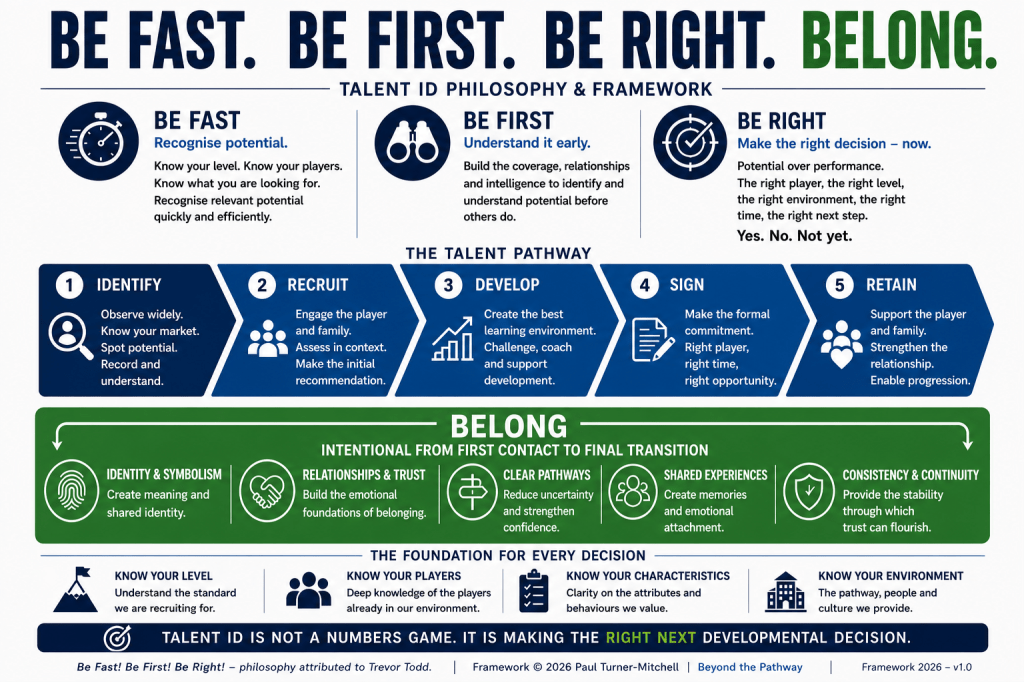
    Be Fast. Be First. Be Right. Belong.

    How can you be fast, first and right?

    When I first heard the philosophy, Be Fast made sense. Talent identification is competitive and, when potential emerges, you need to recognise it quickly. Be First made sense too. Identifying potential before somebody else does can create an obvious advantage.

    But Be Right?

    That was the part I initially found daunting.

    How can you possibly be fast, first and right when assessing young children? At pre-academy ages, you might be observing a six, seven or eight-year-old whose eventual footballing destination will not become clear for another decade.

    Between that first observation and the player they might eventually become sit growth and maturation, coaching, family circumstances, confidence, motivation, injury, opportunity, relationships, environment and thousands of developmental experiences nobody standing beside a grassroots pitch can predict.

    For a while, I struggled with how those three expectations could coexist.

    Then it clicked.

    Know your level.

    That realisation became fundamental to how I think about Talent ID.

    Know your level — and really know it

    Talent ID is sometimes discussed as though the scout’s job is simply to go out and find “good players”.

    For me, that isn’t enough.

    There is no universal definition of good enough. The more meaningful question is:

    Does this player have the potential to thrive at the level I am recruiting for?

    The reference point for a Category 3 Academy will differ from Category 2 and Category 1. But even two Category 1 Academies may be looking for different things because their football philosophies, player characteristics, existing player populations, development models and pathway opportunities may differ.

    Knowing your level therefore means much more than understanding the category above the Academy door.

    If I am responsible for recommending an U8 player, I should already have a detailed understanding of the U8 players — and the relevant wider pre-academy players in other groups — within my own environment.

    How can I confidently recommend a player for an age group if I don’t know the players already operating within it?

    I need to understand where the level currently sits, the characteristics already within the group, what individual players do particularly well, where their developmental needs lie and what potential exists within the population already inside the pathway.

    Only then does my external observation have meaningful context.

    That thinking has developed for me into four foundations for Talent ID decision-making:

    Know your level. Know your players. Know your characteristics. Know your environment.

    They are interconnected. Knowing your level without knowing the players already operating within it is difficult. Knowing your players without understanding the characteristics your club values provides little strategic context. And all those judgements have to be made with an understanding of the environment and pathway into which you may be bringing the child.

    Moving beyond the machine-gun approach

    This is also where what I call the machine-gun approach to Talent ID begins to disappear.

    Fire enough bullets and eventually one will hit the target.

    Recommend enough players, bring enough children through the door and statistically some will progress. Years later, point to the successful player as evidence that the Talent ID was right.

    But volume can disguise the quality of decision-making.

    The objective shouldn’t simply be to recommend more players. It should be to make better-informed recommendations about the right players.

    If I recommend a player, I should be capable of explaining why. What am I seeing? Which characteristics interest me? How do those characteristics relate to what our club values? How does the player compare with the population already within our environment? Am I seeing potential or simply current performance? What don’t I know yet? Is our environment the appropriate next developmental opportunity?

    If I cannot answer those questions, what exactly is my recommendation based upon?

    That doesn’t remove subjectivity from Talent ID. Nor should we pretend it does. Human judgement remains fundamental.

    But judgement should be informed, contextual and explainable.

    For me, that is the difference between simply spotting players and understanding Talent ID.

    Potential over performance

    Knowing your level has to sit alongside clarity about the player characteristics your club values.

    Different clubs will prioritise different things because they have different football philosophies and different ideas about what a player might eventually need to operate successfully within their environment.

    That clarity creates a common reference point without trying to turn scouts into identical decision-making machines. It also allows us to move beyond the question, “Do I like this player?”, towards something more useful:

    “What am I seeing that suggests this player has characteristics capable of translating to our level?”

    At the youngest ages, however, another distinction is fundamental to my thinking:

    Potential over performance.

    Young players develop at different rates. Physical maturation, experience, confidence and opportunity can significantly influence what we see on a particular day.

    The child dominating a grassroots match today may not necessarily possess the greatest long-term potential. Equally, the player having relatively little influence on today’s game shouldn’t automatically be dismissed.

    Talent ID requires us to look beyond what the player is today and consider what they might become tomorrow.

    That isn’t fortune telling. It is informed judgement under uncertainty.

    And that distinction changed how I came to understand Be Right.

    Being right does not mean predicting the future

    Being right cannot mean accurately predicting the career of an eight-year-old. Nobody can know definitively where that child will be in ten years.

    Instead, the question I would ask is:

    Given what I can see today, what I know about our level, the characteristics our club values and my understanding of potential, is this the right developmental opportunity for this player now?

    That final word is critical.

    Now.

    Sometimes the answer will be yes. Sometimes it will be no. And sometimes a perfectly legitimate Talent ID decision is:

    Not yet.

    A player can interest you without the appropriate response automatically being to bring them into your pathway.

    Six months later, the answer may legitimately be different. The child may have developed technically, matured physically or emotionally, grown in confidence or simply benefited from remaining within their existing environment for a little longer.

    That doesn’t necessarily make the original judgement wrong. The player developed and the context changed.

    It is also why I don’t interpret Be First as simply meaning sign the player before another club does.

    You can be first to recognise potential, understand what you are seeing and still conclude that now isn’t the appropriate time to act. The confidence to say “not yet” can be every bit as important as the confidence to recommend.

    For me:

    Be Fast is about recognising relevant potential efficiently.

    Be First is about having the coverage, relationships, knowledge and intelligence to understand that potential early.

    Be Right is about making the appropriate developmental decision for that player, at that level, within that environment — now.

    What happens when we look back?

    One of the privileges of having worked within a Talent ID system and then watching players develop over many years is that eventually you can look backwards at the outcomes.

    Manchester City provides some particularly interesting examples.

    As we enter the 2026/27 season, the first-team picture we have been discussing includes six Academy products: Phil Foden, Rico Lewis, Nico O’Reilly, Kaden Braithwaite, Floyd Samba and Ryan McAidoo. Five of those six — Foden, Lewis, O’Reilly, Braithwaite and Samba — have journeys stretching back to the earliest stages of City’s development system, the pre-academy.

    With the manager publicly discussing a 23-player squad, six Academy products would represent 26.1%, while those five early-pathway players alone would represent 21.7%.

    But first-team players retained by Manchester City represent only one form of outcome.

    Look beyond City’s first team and other developmental journeys become equally interesting. Cole Palmer entered City’s system at the pre-academy and progressed through the pathway. Shea Charles began within City’s early development environment before progressing through the Academy, captaining the EDS and reaching the senior team, with his journey ultimately taking him back into the Premier League with Fulham. Reigan Heskey entered the pre-academy, progressed through the age groups, reached City’s U21s and senior team and moved permanently to the Bundesliga with 1. FC Köln this summer.

    Different players. Different journeys. Different destinations.

    And that is precisely the point.

    The person identifying Shea Charles as a young child didn’t need to predict Fulham. Nobody identifying Reigan Heskey at pre-academy age needed to predict Köln. Nor did anybody observing Cole Palmer need to predict the precise route his senior career would eventually take.

    That wasn’t the Talent ID decision.

    The decision was whether the characteristics and potential they could see justified the next developmental opportunity within that environment at that time.

    What happened afterwards was development.

    No individual player’s career can prove that a Talent ID strategy works. Too many variables contribute to development to make that causal claim. But when similar early identification decisions repeatedly result, across cohorts and over time, in players progressing into senior professional football — both at the originating club and elsewhere — the longitudinal pattern becomes increasingly significant.

    It also challenges how we define Talent ID success.

    The measure cannot simply be: How many became first-team players here?

    We should also be interested in players who establish professional careers elsewhere, the levels they ultimately reach, the developmental opportunities created along the way and the quality of the decisions made throughout their journey.

    Talent ID isn’t about predicting the destination. It is about making the right next developmental decision.

    Strategy is only as good as the people delivering it

    There is another lesson from that environment which has become increasingly important to how I think about Talent ID strategy.

    Strategies don’t identify players. People do.

    My professional career approaching three decades has spanned law, leadership, strategic communications and public policy, alongside my years within academy football. That has exposed me to different leaders, organisational cultures and working environments.

    Against that much broader backdrop, Trev remains the best leader I have worked under.

    What made him exceptional was not simply the Talent ID philosophy. It was the team he created and what it felt like to be part of it.

    There was an energy and enthusiasm that came simply from pulling on the club tracksuit. You wanted to be there, you wanted to contribute and you wanted to deliver — not because somebody was constantly checking whether you were doing your job, but because you felt part of something that mattered.

    Above all, everyone cared.

    We cared about the environment, about each other, about the children and their families, and about delivering.

    That care created its own standards. Trust didn’t mean an absence of accountability; if anything, it increased it. When you genuinely feel part of a team, when your contribution matters and when the people around you matter, you don’t want to let them down.

    Looking back through the lens of my subsequent research, I now have a word for what Trev created.

    Belonging.

    That belonging generated energy, enthusiasm, responsibility and a collective hunger to deliver. The philosophy provided clarity about what we were trying to achieve; Trev’s leadership created an environment in which people cared deeply about delivering it.

    That matters to anybody responsible for leading Talent ID. You can have excellent processes, sophisticated data, extensive coverage and beautifully written player profiles, but if the people responsible for exercising judgement don’t feel trusted, valued and connected to the purpose, something fundamental is missing.

    I experienced belonging before I studied it

    Years later, belonging became central to my own thinking for a different reason.

    During the 2022/23 season, I undertook The FA Level 3 in Advanced Principles of Talent Identification in Football, led by Ed Cope. One of the modules introduced me more formally to belonging, alongside reading and ideas that would become increasingly influential in my work.

    The drives to and from St George’s Park also gave me something that can be surprisingly difficult to find in football: time and headspace to think.

    My starting point was practical and firmly rooted in Talent ID.

    We could work incredibly hard to Be Fast, Be First and Be Right, identify potential early and create an opportunity for that child within our environment. But recruitment creates another strategic challenge:

    Once you have identified potential, how do you retain it?

    That became the starting point of my research.

    Could belonging operate as a retention mechanism at pre-academy ages? If a child and their family developed a stronger connection with the club, its people and its environment, might that strengthen their relationship with the Academy and help retain the potential we had worked so hard to identify?

    The work that eventually became Beyond the Pathway began with that relatively focused question around pre-academy retention before developing into a much broader exploration of belonging, culture, stewardship and human development.

    Retention was the doorway.

    It wasn’t the destination.

    Belonging cannot begin at retention

    The deeper I went into belonging, the more my original question changed.

    I began applying the concept in practice, researching it more deeply and eventually making it the focus of my academic thesis. I explored frameworks through which Academies might think more intentionally about belonging and developed my thinking around emotional resonance — the emotional significance that people, relationships, places and experiences can acquire for a young person.

    Rather than simply asking whether belonging might help us retain potential, I became interested in whether belonging could form part of the conditions through which potential is able to flourish.

    Could feeling known, valued and connected influence how comfortably a child expresses themselves? Could relationships affect confidence and willingness to take developmental risks? Could belonging help young people navigate setbacks? What role do parents, coaches, teammates, identity, culture and environment play in the developmental experience?

    Those questions eventually took me well beyond retention and contributed to what became Beyond the Pathway.

    And they led me to an important conclusion for Talent ID strategy:

    Retention may be one place where we observe the effect of belonging. It is far too late to start creating it.

    If belonging matters, it has to be cultivated intentionally from the very beginning of the relationship and continue throughout the player’s journey.

    That means belonging matters at Identify, because the scout may represent a child and family’s first meaningful interaction with the club. It matters at Recruit, as relationships begin to form and the family starts to understand the environment. It matters throughout Develop, through the experiences, relationships and sense of identity that shape how a young person feels within the Academy. It matters at Sign, as the relationship and commitment evolve, and it matters at Retain, through continued development, connection and progression.

    It also matters at the other end of the journey.

    Final transition is still part of the experience.

    Whether a young person progresses into senior football, moves to another club or leaves the pathway altogether, how an organisation handles that transition says something about the environment they belonged to.

    Designing belonging intentionally

    This is where my Talent ID thinking now connects directly with the Five-Pillar Belonging Framework developed in Beyond the Pathway:

    Identity & Symbolism — creating meaning and shared identity.

    Relationships & Trust — building the emotional foundations of belonging.

    Clear Pathways — reducing uncertainty and strengthening confidence.

    Shared Experiences — creating memories and emotional attachment.

    Consistency & Continuity — providing the stability through which trust can flourish.

    These are not interventions to introduce when a player becomes a retention risk. They are conditions to cultivate intentionally throughout the pathway.

    That distinction matters.

    My evolution of the original philosophy therefore isn’t best understood as a linear sequence in which we Be Fast, then Be First, then Be Right and finally Belong.

    Instead, I see Be Fast, Be First and Be Right as principles informing Talent ID decision-making across a pathway of:

    IDENTIFY → RECRUIT → DEVELOP → SIGN → RETAIN

    while BELONG intentionally underpins that entire journey:

    from first contact to final transition.

    The book makes the same broader distinction: frameworks alone do not create belonging; people and everyday behaviours turn those structures into lived experiences.

    And that brings me back to Trev.

    I went looking for belonging academically because I wanted to understand whether it could help us retain young talent. It took me years to recognise that I had already experienced its power within the team responsible for identifying that talent.

    An evolution, not a replacement

    I wouldn’t replace Be Fast! Be First! Be Right!

    I lived and breathed it. I was part of the environment in which it operated, and with the benefit of time we can observe many of the developmental outcomes that followed.

    It was tried, tested and delivered.

    My question is the one high-performance environments should continually ask:

    Where is the next marginal gain?

    For me, that has become:

    BE FAST. BE FIRST. BE RIGHT. BELONG.

    BE FAST
    Recognise relevant potential efficiently by knowing your level and your players.

    BE FIRST
    Build the coverage, relationships and intelligence that allow you to identify and understand potential early.

    BE RIGHT
    Prioritise potential over performance and make an informed, contextual judgement about the appropriate next developmental opportunity — now.

    BELONG
    Intentionally create the conditions through which connection, development and human potential can flourish — from first contact to final transition.

    Belong isn’t an attempt to correct the original philosophy. It is my evolution of something I know delivered because I was part of delivering it.

    There is also a symmetry to it that I hadn’t appreciated when my research began.

    Trev created belonging among the people responsible for executing the Talent ID strategy.

    My subsequent work asked how we might create belonging more intentionally for the young people and families experiencing the pathway.

    That is the marginal gain that interests me.

    Talent ID is not a numbers game

    If there is one thing I would want a scout to take from this framework, it is that Talent ID should demand more of us than spotting somebody who looks good on a Saturday or Sunday morning.

    Know your level. Know your players. Know your characteristics. Know your environment.

    Then ask the difficult questions. What am I actually seeing? Is it performance or potential? How does it compare with what already exists within our environment? What don’t I yet know? Is this the right developmental opportunity for this player? And is it right now?

    Sometimes the answer will be yes. Sometimes no. Sometimes not yet.

    All three can represent good Talent ID decisions.

    For those responsible for leading Talent ID, the challenge is broader. Build the strategy, coverage and intelligence that allow people to Be Fast. Give scouts sufficient knowledge of their level, players and characteristics to Be First in understanding relevant potential. Create the clarity, trust and accountability that enable people to exercise their judgement and Be Right.

    Then recognise that bringing a young person into the pathway is not the end of recruitment. It creates another responsibility: to build an environment in which that person has the opportunity to develop and flourish.

    That is where Belong sits.

    Not at the end of the pathway, but throughout it.

    From first contact to final transition.

    Talent ID is not a numbers game. It is about making the right next developmental decision — and then creating an environment worthy of the potential we have identified.

    Be Fast. Be First. Be Right. Belong.

    An evolution of a philosophy I lived and breathed, shaped by everything I have learned since.

    And the ambition behind it:

    Always Dream Bigger!

  • The Learning I Didn’t Know I Needed: EDI, Intentionality and the Adults Who Develop Our Young Players

    There was one part of the inaugural Premier League Future Academy Leaders programme that, if I am candid, I wasn’t particularly looking forward to: EDI — equality, diversity and inclusion.

    Not because I disagreed with any of it. Far from it. I simply expected it to be rather dry. I had also been fortunate in life. I had a privileged upbringing and had never knowingly experienced prejudice or discrimination because of who I was. I considered myself open-minded, fair and respectful of others, so perhaps subconsciously I didn’t expect the session to challenge me particularly deeply.

    It did.

    I remember feeling quite naive as I listened to people talk about the reality of prejudice in their everyday lives. I was genuinely shocked by some of what I heard. These weren’t historical examples or abstract scenarios constructed for a training course. They were people’s lived experiences — things they had encountered simply going about their lives that I had never experienced and, consequently, had never really been required to think about.

    That stayed with me. With hindsight, there is an important lesson in the fact that I wasn’t particularly looking for that learning in the first place.

    Sometimes the learning we don’t think we need is the learning we need most.

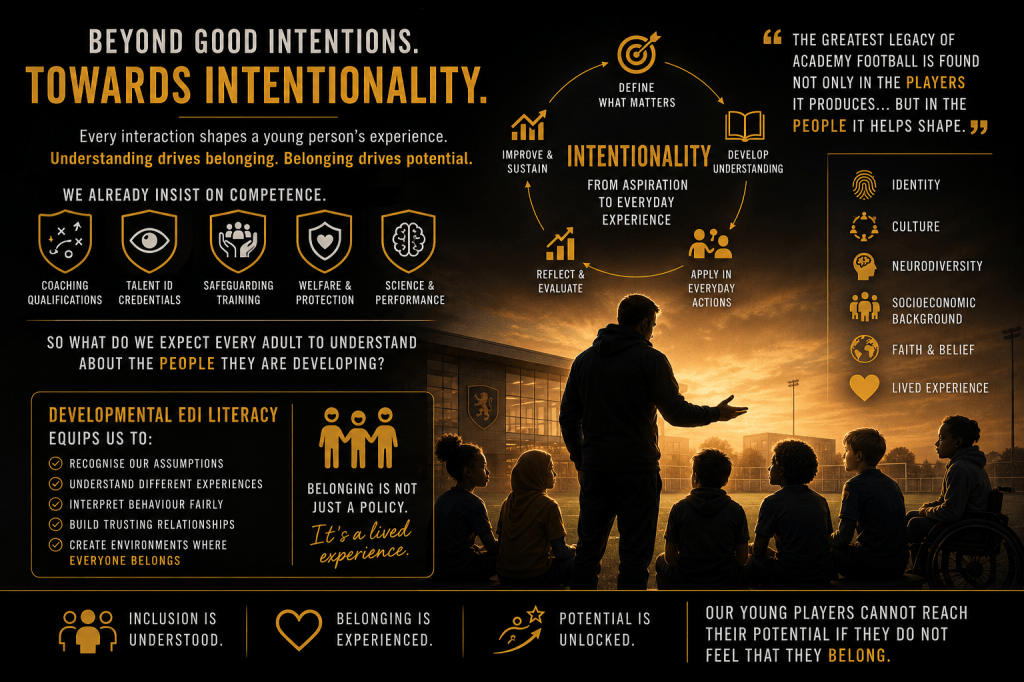
    Good intentions aren’t the same as understanding

    There is an uncomfortable but important distinction here. Someone can be a decent person and still have blind spots. Someone can genuinely believe in equality while having limited understanding of an experience completely outside their own. Someone can care enormously about children while interpreting their behaviour through the lens of their own upbringing, culture and experiences.

    My lack of awareness wasn’t caused by hostility towards anybody. In many respects, it was the opposite problem: my own life had never required me to understand.

    There will inevitably be people working in football whose experience is similar to mine, and that matters particularly in academy football because adults aren’t simply delivering football sessions. They are constantly interpreting children.

    A coach makes judgements about confidence, attitude, communication, learning and responses to challenge. A scout interprets personality, behaviour and family engagement alongside football ability. Player-care staff build relationships with children and parents. Medical practitioners support young people through injury and uncertainty. Academy leaders determine what gets discussed, prioritised, developed and rewarded.

    Every one of those interactions takes place between people whose lives may be very different. Race, religion, culture, disability, neurodiversity, socioeconomic circumstances, family structures, identity, language and previous experiences can all shape how somebody experiences an environment. The adult brings their own lived experience into that interaction too.

    Sometimes what we think we are observing may therefore tell us as much about our own frame of reference as it does about the child in front of us.

    Football already understands professional competence

    This is where I keep returning to one word throughout much of my thinking about academy football:

    Intentionality.

    Football is extraordinarily intentional about many of the things it considers important. We don’t simply decide that somebody seems knowledgeable about football and allow them to coach at the highest levels of youth development. Coaching has qualification pathways. Talent identification has professional qualifications and role requirements. Safeguarding is treated as a responsibility requiring education rather than something we assume people understand because they happen to be decent human beings.

    The same principle runs throughout EPPP. Once something is regarded as important to the quality of the academy environment, football has demonstrated an ability to define expectations, develop expertise, establish frameworks and evaluate practice.

    That is intentionality: deciding something matters and then building the capability to do it well.

    Which raises a question I increasingly find myself asking:

    What should an adult entrusted with developing children be expected to understand about the different human beings they are developing?

    This isn’t an argument that football ignores EDI

    It is important to be absolutely clear about this. The Premier League deserves considerable credit for the work it has undertaken around equality, diversity and inclusion.

    The South Asian Action Plan is a particularly relevant example. Developed with Kick It Out to address the under-representation of British South Asian players within academy football, it has sought to understand barriers, create opportunities, engage communities and improve representation. Importantly for this discussion, the programme has also included EDI education for Talent ID and recruitment professionals.

    By April 2025, more than 3,000 children and 400 grassroots coaches had engaged with the programme through 24 Premier League and EFL clubs.

    There is intentionality elsewhere too. The Premier League introduced an Anti-Racist Coaching workshop for academy staff, designed to develop culturally aware environments through inclusive practice. At Wolves, one of the clubs involved, participation extended beyond coaches to physios, analysts, scouts and player-care staff — an important recognition that a child’s academy experience is shaped by considerably more people than the person delivering the football session.

    So my question isn’t whether the Premier League takes EDI seriously. The evidence says that it does.

    The question I’m interested in is slightly different: how deeply and consistently does that literacy penetrate the everyday developmental environment experienced by children?

    From organisational EDI to practitioner literacy

    I don’t think the answer is necessarily another certificate. Indeed, if we’re not careful, that could miss the point entirely. Complete an online module, answer some multiple-choice questions, download the certificate and put it on the personnel file. Compliance achieved; understanding unchanged.

    What interests me much more is practitioner literacy.

    Can a scout recognise that their interpretation of confidence, communication or parental engagement might contain cultural assumptions? Can a coach understand why children may experience exactly the same environment differently? Can practitioners recognise when expectations around behaviour reflect their own experience rather than some universal definition of what a “good academy player” should look like?

    And do the adults around young players understand enough about race, religion, disability, neurodiversity, socioeconomic difference, identity and family circumstances to become curious when something falls outside their own experience, rather than immediately judging it?

    That last point feels particularly important because my experience on Future Academy Leaders taught me something very simple: not having experienced prejudice doesn’t equip you to understand what it feels like to experience it.

    Listening helps. Education helps. Relationships help. Exposure to experiences beyond our own helps. Most importantly, curiosity helps.

    Those things can be developed intentionally.

    Why EDI didn’t become a major part of Beyond the Pathway

    EDI featured within my research and thinking while writing Beyond the Pathway, but I ultimately chose not to make it a standalone part of the book. That wasn’t because I considered it unimportant; quite the opposite.

    Equality, diversity and inclusion is an enormous field in its own right. I didn’t want to pretend I could adequately address its breadth within a book primarily concerned with belonging, human development, organisational culture, stewardship and the purpose of academy football.

    Instead, I became increasingly interested in something closely connected to it: lived experience.

    An organisation can possess excellent policies and still be experienced differently by different people. It can publish compelling values while somebody within it feels that they don’t belong. It can demonstrate a genuine commitment to inclusion at organisational level while everyday interactions inadvertently communicate something very different.

    That is one reason belonging became so central to my thinking. Not as a substitute for EDI, but because belonging takes us from organisational intention towards an intensely human question:

    What does this environment actually feel like to the person experiencing it?

    That moves the conversation from policy into practice, and from organisational intention into everyday behaviour.

    Belonging cannot require sameness

    Organisations naturally develop norms: this is how we do things here. In healthy cultures those norms can create identity, consistency and shared purpose. But there is a danger if belonging becomes conditional upon conforming to them.

    If the price of belonging is behaving, communicating, thinking or presenting yourself exactly like everybody else, we haven’t really created belonging. We have created conformity.

    The developmental challenge therefore isn’t simply to bring children from different backgrounds through the academy door. It is to create an environment capable of understanding them once they arrive.

    That requires adults with sufficient developmental and cultural literacy to recognise difference without automatically interpreting difference as deficiency. It also requires organisations curious enough to ask whether different people actually experience their culture in the way leaders intend.

    The intentionality test

    This takes me back to the question I keep asking about academy football.

    When something matters to performance, we become extraordinarily intentional. We establish frameworks, create qualifications, collect data, employ specialists, develop staff, benchmark, audit and review. We ask what better looks like and then construct systems designed to get us closer to it.

    Human development should provoke the same organisational instinct.

    Not because children can be reduced to dashboards. Not because belonging can be given a definitive score. And certainly not because EDI can be solved through compulsory e-learning. It is because good intentions are not evidence of good experiences.

    The Premier League’s work demonstrates that football can act intentionally in this space. The South Asian Action Plan, inclusive coaching initiatives, player education and anti-racism work provide examples of that intentionality in practice.

    The question I am increasingly interested in is how far we take it.

    Across academy football there are thousands of adults involved in children’s development. Coaches, scouts, analysts, medical practitioners, player-care staff, teachers, administrators and leaders. Between them sit thousands of relationships and countless apparently insignificant everyday interactions through which young people learn whether they are understood, respected, valued and whether they genuinely belong.

    Perhaps, therefore, the question isn’t simply whether an organisation has an EDI strategy. It is whether we have decided what every adult working with our children should reasonably be expected to understand — and how intentionally we are helping them to understand it.

    I went into that EDI session believing myself to be a fair-minded person who understood the importance of treating people properly. I came out recognising how much I didn’t know.

    It didn’t make me an EDI expert. It did something arguably more useful: it made me more curious.

    That curiosity sits at the heart of what I later described in Beyond the Pathway as developmental literacy. If academy football is serious when it says it develops people as well as players, then understanding the people in front of us cannot be left to good intentions alone.

    Because one of the central questions I pose in the book remains:

    “If we say we develop people as well as players, how do we know?”

    And increasingly, I think the same principle applies here.

    If we say every child belongs, how intentionally are we preparing the adults around them to make that true?

  • Shea Charles: When 27 Minutes of First-Team Football Becomes a £30 Million Academy Success Story

    Screenshot

    What does success really look like for an elite football academy?

    It is tempting to answer that question by counting first-team appearances. How many academy players make their debut? How many establish themselves? How many reach 50 or 100 appearances for the club that developed them?

    Those are important measures, but they are not the only measures. The journey of Shea Charles offers a compelling alternative perspective.

    Charles spent the overwhelming majority of his childhood and youth development within Manchester City’s system, progressing from the club’s pre-academy environment into the Academy at Under-9, through the age groups to the Elite Development Squad, captaining City’s Under-21s, becoming a senior international while still within the development pathway and eventually making his Premier League debut under Pep Guardiola.

    His Manchester City first-team career amounted to just 27 minutes of Premier League football. Viewed through the narrowest possible lens, therefore, he did not “make it” at Manchester City.

    But consider what happened next.

    City sold him to Southampton for an initial £10.5 million, with the potential for the deal to rise to £15 million, while retaining further economic and strategic rights over the player. Three years later, Charles has been sold to Fulham in a deal reportedly worth up to £30 million, returning him to the Premier League at the age of 22.

    In doing so, he has become the most expensive Northern Ireland footballer in history. Manchester City are also due to benefit financially from that second transfer through the sell-on clause negotiated when he left the Etihad.

    So perhaps the better question isn’t whether Shea Charles made it at Manchester City. Perhaps it is:

    What did Manchester City’s development system ultimately produce?

    The answer is Northern Ireland’s most expensive footballer, a Premier League player and senior international captain.

    That makes his story a fascinating case study in what player development, progression and academy return on investment can really look like.

    From Manchester City’s Pre-Academy to the Academy

    Charles is genuinely a product of Manchester City’s development system. This is an important distinction because he wasn’t recruited from another professional academy at 15 or 16, spent a couple of seasons at City and subsequently became described as an Academy graduate.

    Charles was born in Manchester and was with Manchester City from around the age of seven. There is, however, an important technical distinction to make about those earliest years.

    At seven, Charles was not yet a formally registered Academy player. He was part of City’s pre-academy and early development environment. Children cannot formally enter the Academy system until the Under-9 age group, so Charles’s pathway can properly be understood in two stages.

    First came the pre-academy years: being identified by Manchester City, training within the club’s development environment and beginning to absorb its footballing philosophy before he was old enough to become an Academy player. Then, at Under-9, came the formal transition into Academy football.

    That means Manchester City’s involvement in Charles’s development started even earlier than the formal Academy journey itself: from around seven years old through the pre-academy, from Under-9 through the Academy, and then onwards through Under-18 football, the Elite Development Squad, first-team training and ultimately the Premier League.

    It is a development journey spanning the entirety of his footballing childhood.

    The significance of that should not be overlooked. Academies are sometimes judged according to what happens during the final few years of development — scholarship, Under-18 football, the Elite Development Squad and ultimately the first team — but a player such as Charles represents something much longer.

    Technical development, tactical education, physical and psychological development, different coaches, different phases, different teams, thousands of training hours and hundreds of matches all contributed to a developmental journey measured not in months but in more than a decade.

    By July 2021, aged 17, that journey reached another significant milestone when Charles signed his first professional contract with Manchester City. The boy who had first entered City’s development environment at seven had become a professional footballer.

    His development, however, was far from finished.

    From Academy Player to Elite Development Squad Captain

    The next phase of Charles’s development illustrates another important part of the pathway: he became a winner.

    Charles was part of a hugely successful generation within Manchester City’s Academy. Having helped City’s Under-18s secure the Premier League North and national titles, he progressed into the Elite Development Squad and became an important figure in City’s remarkable sequence of Premier League 2 successes.

    By 2022/23 he wasn’t simply playing for the EDS. He was captaining it.

    Charles was elected captain ahead of the season and subsequently led City to a third consecutive Premier League 2 title, making 26 league appearances during the campaign. Captaining one of the leading development teams in European football at 18 and 19 years old tells us something beyond technical ability. City were developing responsibility, tactical understanding, resilience and leadership alongside footballing ability.

    His positional development is interesting too. Although principally a defensive midfielder, Charles was also educated across centre-back, right-back and more advanced midfield positions. That versatility became an important part of his profile, while the footballing education he received at Manchester City would eventually carry considerable value in the transfer market.

    Becoming a Senior International Before Becoming a City First-Team Player

    There is another remarkable feature of Charles’s development. Before he had even made his Manchester City first-team debut, he was already playing senior international football.

    Having represented Northern Ireland through the age groups, Charles received his first senior call-up in 2022 and made his senior international debut that June. He was still a teenager and had not yet played a minute of senior club football.

    That is quite an unusual development position. Manchester City had produced a player considered ready to represent his country at senior international level before there was realistically space for him in City’s first team.

    Therein lies one of the fundamental challenges facing elite academies. Producing a Premier League-quality footballer does not automatically mean producing a player who can immediately displace an established Manchester City first-team player.

    For Charles, the position was particularly difficult. His preferred role was defensive midfield and Manchester City’s first-team options during his development included Fernandinho and Rodri. The standard wasn’t simply Premier League standard; it was world-class.

    Charles himself has spoken about learning from those players after progressing into the first-team training environment. That proximity to elite performers is itself part of development.

    Eventually, however, development requires something else: playing.

    The 27 Minutes That Completed a 12-Year Journey

    On 28 May 2023, Charles finally reached the end point traditionally associated with academy development. Manchester City travelled to Brentford on the final day of the Premier League season and, in the 63rd minute, Pep Guardiola introduced the 19-year-old Charles for his Premier League debut.

    Twenty-seven minutes.

    That would ultimately be the entirety of his competitive Manchester City first-team career.

    This is where the interpretation of his story becomes important. If academy success is measured solely by first-team appearances for the parent club, Charles barely registers: one appearance and 27 minutes.

    But that ignores virtually everything Manchester City had actually developed.

    By the time Charles left the club, he was a senior Northern Ireland international, a Premier League 2-winning captain, a technically accomplished and tactically versatile midfielder and a player considered capable of senior professional football.

    The question was no longer whether he needed more Academy development. He needed senior football.

    Knowing When Development Needs to Continue Somewhere Else

    This may be the most interesting decision Manchester City made during the entire Shea Charles journey.

    They sold him.

    There is sometimes an assumption that an academy demonstrates its commitment to a young player by keeping him. That isn’t necessarily true. At 19, another season of development football would undoubtedly have provided Charles with something, but 30 or 40 senior matches could provide something very different.

    Manchester City could not guarantee those opportunities. Southampton could.

    So in July 2023, Charles left Manchester City permanently. The reported financial terms were already significant, with Southampton paying an initial £10.5 million and performance-related additions capable of taking the transaction to £15 million.

    For a player who had played 27 minutes of senior club football, that alone represented a considerable realisation of the value created through City’s development pathway.

    But City did something else: they protected the future.

    The deal reportedly included a sell-on clause, matching rights and a buy-back provision. That is important because it changes the nature of the transaction. Manchester City weren’t simply cashing in on an Academy player; they were monetising part of the value they had already created while retaining exposure to the value Charles might create in the future.

    Crucially, Charles was also given the freedom to go somewhere he could play.

    Southampton: From 27 Minutes to a Full Season of Senior Football

    The difference was immediate.

    Charles arrived at Southampton having accumulated just 27 minutes of senior club football. During his first season at St Mary’s he made 38 appearances in all competitions as Southampton attempted to return immediately to the Premier League following relegation.

    Charles was therefore exposed not to carefully managed development football but to the demands of a 46-game Championship season and a promotion campaign. There were starts and substitute appearances, difficult games and mistakes, periods in the team and periods outside it.

    That matters because development isn’t simply the accumulation of successful moments. It is also the accumulation of experiences.

    By the conclusion of the season, Southampton had won promotion and Charles had gone from 27 senior club minutes to 38 competitive appearances. Manchester City’s development pathway had prepared him for senior football; Southampton was now providing the environment in which he could learn how to live in it.

    Sheffield Wednesday: The Next Development Environment

    The next decision was equally important. Rather than remain on the fringes following Southampton’s promotion to the Premier League, Charles joined Sheffield Wednesday on loan for the 2024/25 season.

    Again, the priority was minutes and the environment mattered.

    At Hillsborough, Charles played 44 matches. This time he wasn’t simply gaining experience; he became one of Sheffield Wednesday’s most important players and at the end of the campaign was named the club’s Player of the Year.

    Consider the progression. At 19 he had 27 minutes of senior club football. At 20 he had experienced a Championship promotion campaign. At 21 he had accumulated another 44 appearances and become Player of the Year at Sheffield Wednesday.

    Meanwhile, his international career continued to develop. In November 2024, Charles captained Northern Ireland and, at just 21, became the youngest player ever to captain his country.

    The leadership qualities evident when Manchester City entrusted him with the EDS captaincy were now manifesting themselves at senior international level.

    The pathway was continuing. It simply wasn’t happening at the Etihad anymore.

    Returning to Southampton a Different Player

    Charles returned to Southampton with considerably more senior experience. The player who had originally left Manchester City with 27 senior club minutes now had two demanding Championship seasons behind him alongside an increasingly significant international career.

    During 2025/26, his market value accelerated again. He made 38 appearances, scoring six goals and providing two assists, while his performances attracted Premier League interest.

    Leeds United pursued him. Crystal Palace were linked. Fulham entered the race.

    Southampton rejected offers as the value of an asset originally acquired from Manchester City for £10.5 million continued to increase. Eventually Fulham secured him in a deal reportedly worth £26 million initially, potentially rising to £30 million through add-ons.

    Three years after Manchester City sold him, Shea Charles was returning to the Premier League.

    Now he wasn’t a 19-year-old prospect with 27 senior minutes. He was a 22-year-old established senior professional, a full international and a national-team captain.

    The significance of the fee also extends beyond Southampton or Manchester City. The Irish Football Association has confirmed that the Fulham move makes Shea Charles Northern Ireland’s most expensive footballer in history.

    That is quite some destination for a journey that began in Manchester City’s pre-academy environment at seven years old.

    And Manchester City Benefit Again

    This is where the economics of elite player development become particularly interesting.

    Manchester City did not simply receive the original transfer fee. When Charles moved to Southampton in 2023, City protected their position through a sell-on provision, with reports surrounding the 2026 transfer consistently placing that sell-on percentage at 15 per cent.

    The precise contractual calculation is not publicly available, and that distinction matters. Some reporting describes City as entitled to 15 per cent of a subsequent transfer fee, while other reporting describes the provision as 15 per cent of Southampton’s profit on the player.

    Without access to the transfer agreement itself, it would be wrong to present one interpretation as contractual fact. But either mechanism produces a significant second financial return for Manchester City.

    If the reported clause applies to the whole subsequent transfer fee, City’s share of Fulham’s reported £26 million guaranteed consideration would be approximately £3.9 million. Should the full £30 million eventually become payable and fall within the clause, that figure would rise to £4.5 million.

    If, alternatively, the 15 per cent applies only to Southampton’s profit, the calculation is lower. Using the reported £10.5 million initial Southampton purchase price as the simplest starting point, the £15.5 million difference on Fulham’s initial £26 million consideration would generate approximately £2.325 million for City.

    If the Fulham transaction ultimately reaches £30 million, the equivalent simple calculation would produce approximately £2.925 million.

    The actual contractual calculation could differ. It may, for example, account for add-ons paid by Southampton to City, particular transaction costs or specify precisely which components of Fulham’s consideration are included.

    But the broader point does not change.

    Manchester City are receiving another multimillion-pound return from a player who left the club three years ago.

    The Economics of the Entire Journey

    Step back and consider the complete picture.

    Manchester City’s involvement in Charles’s development began when he was approximately seven. There was no transfer fee paid to another professional club to acquire a developed teenage player. Instead there was a long-term investment beginning in the pre-academy, continuing through formal Academy registration from Under-9 and encompassing years of coaching and competition, Under-18 football, Elite Development Squad football, first-team training and eventually a Premier League debut.

    At 19, City converted part of the value created by that development into an immediate transfer receipt of £10.5 million guaranteed, with the Southampton transaction reportedly capable of rising to £15 million.

    They simultaneously retained contractual exposure to his future development. Three years later, Charles’s transfer to Fulham has potentially generated a further multimillion-pound payment.

    Depending upon the precise sell-on mechanism and achievement of the various add-ons, Manchester City’s cumulative receipts associated with Charles could therefore move well beyond the original £10.5 million and potentially towards the high teens.

    It is important to describe that correctly. This isn’t literally £15 million or £19 million of “profit”. Manchester City spent considerable money developing Charles for more than a decade. Academies require coaches, facilities, medical provision, sports science, education, analysis, safeguarding, recruitment and countless other resources. There is a real development cost.

    But there is no conventional transfer acquisition fee being amortised in the way there would be with a player bought from another professional club.

    That makes the economic value generated by successful Academy development particularly powerful, and it is why the Shea Charles story is about far more than one transfer.

    Development and Financial Return Are Not Competing Objectives

    There can sometimes be discomfort when academy development and money are discussed together. Youth development should, rightly, be about the player, but that doesn’t mean financial return is somehow illegitimate.

    In fact, the Charles journey demonstrates how the two objectives can align.

    Manchester City developed him to a point where he was ready for senior football, but City could not realistically promise him the volume of senior football he needed. Southampton could. City therefore allowed the player to leave permanently rather than retaining him indefinitely within a pathway that might no longer have served his development.

    Charles got opportunity. Southampton got a highly developed young footballer. Manchester City received substantial value for the development work undertaken over the previous decade-plus and retained a financial interest in what happened next.

    That is not development being sacrificed for economics. It is development creating economics.

    The £30 Million Question: Did Shea Charles “Make It”?

    Which brings us back to the question with which we started.

    Did Shea Charles make it at Manchester City?

    If the test is 100 Manchester City first-team appearances, the answer is no. The same applies if the threshold is 50, or even ten.

    He made one appearance lasting 27 minutes.

    But perhaps that is the wrong test.

    Manchester City’s relationship with Charles began when he was a seven-year-old boy within its pre-academy development environment. At Under-9, he formally entered the Academy and the club then helped develop him through virtually every stage of the pathway.

    He became a national age-group player, an Academy champion, an EDS player and then EDS captain. He became a senior international and eventually a Manchester City first-team player.

    When the appropriate next developmental environment was no longer Manchester City’s Academy, he moved into senior football. He became a Championship player, a promotion winner, a club Player of the Year, Northern Ireland’s youngest-ever captain and an established senior professional.

    Now, at 22, he is Northern Ireland’s most expensive footballer in history, following a transfer potentially worth £30 million.

    Manchester City also turned that development journey into potentially well over £10 million and possibly approaching £20 million in cumulative transfer-related receipts, depending upon the original and subsequent add-ons and the precise operation of the sell-on clause.

    So did Shea Charles make it?

    Absolutely. He just didn’t make his career at Manchester City.

    Academy Success Cannot Be Measured by One Destination

    That distinction matters because the overwhelming majority of children entering an elite academy will never become established first-team players at that club.

    At Manchester City, the challenge is greater still. An Academy player isn’t simply trying to become good enough for professional football; he is potentially trying to become good enough to play for one of the strongest first teams in world football.

    Those are very different thresholds.

    If the only definition of successful development is producing a player capable of displacing world-class internationals, then even an extraordinary academy will appear to fail far more often than it succeeds.

    But that isn’t what development should mean.

    An elite academy should also be judged by whether it prepares young people to progress. For some, progression will mean Manchester City’s first team. For others, it will mean another Premier League club, the Championship, League One, League Two, European football or international football. For others still, the eventual destination will be something outside professional football altogether.

    The destination will be different for every player.

    The responsibility of development is to prepare them as well as possible for that destination.

    From Player Development to Value Creation

    There is also a wider strategic lesson. An Academy can create sporting value without the player becoming a first-team regular, and it can create considerable financial value at the same time.

    The Charles transaction illustrates a sophisticated model: develop the player, progress him through the pathway, recognise when another environment offers something the current one cannot, allow him to move, realise part of the value already created, protect exposure to future value and then benefit if the player continues to develop.

    That final point is particularly important.

    A sell-on clause effectively allows the developing club to participate economically in development that happens after the player leaves. Manchester City had already spent more than a decade helping develop Shea Charles. Southampton then invested three further years in his senior development, including facilitating the loan to Sheffield Wednesday. Fulham are now purchasing the player those combined environments helped create.

    The value chain is visible.

    City’s 2023 negotiation ensured that the club which undertook the earliest and longest part of that development journey remained economically connected to its eventual outcome.

    More Than a Production Line

    There is sometimes a tendency to describe successful academies as “production lines”. The phrase is understandable, but it risks making player development sound mechanical.

    Children aren’t products, development isn’t linear and careers don’t follow predetermined routes.

    Shea Charles’s journey demonstrates that perfectly. His pathway has encompassed pre-academy development, Academy football, a professional contract, Under-18 football, the Elite Development Squad, captaincy, international football, first-team training, a Premier League debut, permanent transfer, Championship football, promotion, a loan, Player of the Year recognition, international captaincy, another permanent transfer and Premier League football again.

    Now add another milestone: Northern Ireland’s record transfer.

    At several points, his development environment changed. But the pathway continued.

    That may ultimately be one of the most important lessons from his story.

    The success of an Academy pathway should not be determined solely by where the player finishes it. It should also be determined by what the pathway has prepared that player to become.

    27 Minutes Tell Us Almost Nothing

    If we looked only at Shea Charles’s Manchester City first-team statistics, we would see one appearance and 27 Premier League minutes.

    That tells us almost nothing about the success of his development.

    A more meaningful assessment would recognise that he was with Manchester City from approximately seven years old, formally entered the Academy from Under-9, spent more than a decade developing within City’s pathway, captained the EDS, became a senior international while still a City development player and subsequently became Northern Ireland’s youngest-ever captain.

    The economics tell another part of the story. More than £10 million was generated when he first left City, a second multimillion-pound return has potentially been generated three years later and the player himself has now commanded a subsequent transfer worth up to £30 million.

    At 22, he is back in the Premier League as Northern Ireland’s most expensive footballer in history.

    Those numbers tell a very different story from 27 minutes.

    Shea Charles may only have played 27 minutes of senior football for Manchester City, but Manchester City didn’t merely develop a player capable of playing 27 minutes for Manchester City.

    They helped develop Northern Ireland’s most expensive footballer.

    Perhaps that is a better way to understand what a successful elite Academy pathway can really achieve.

    A Personal Footnote

    There is a personal element to this story for me too. I had the privilege of watching Shea play for Manchester City’s Elite Development Squad over a number of years.

    What we see now at senior level did not suddenly appear when he left Manchester City. You could see the quality, composure, tactical intelligence and maturity developing through those Academy years.

    That is perhaps why his journey is such an interesting one to reflect upon. Those of us who spend time around Academy football inevitably see talented young players at different points in their development. We see snapshots of a journey without necessarily knowing where that journey will eventually take them.

    In Shea Charles’s case, it has taken him from Manchester City’s pre-academy as a seven-year-old, through the Academy, to EDS captain, Premier League debutant, senior international, Northern Ireland captain and now the most expensive Northern Irish footballer of all time.

    And he is still only 22.

    Having watched part of that journey, I wish Shea every success at Fulham and in the next stage of his career. More importantly, I hope the journey continues, because perhaps the most exciting thing about this particular Academy success story is it is likely to be still some considerable way from being finished.

  • FutureFit and Professional Pre-Academies: What Do the New Rules Actually Mean for U6, U7 and U8 Games?

    The Football Association’s FutureFit reforms take effect for the 2026/27 season and introduce significant changes to the playing formats through which children experience youth football.

    The headline change is familiar: 3v3 becomes the entry format at Under 7, while 5v5 continues at Under 8 before children progress through larger formats as they get older.

    The FA describes the changes as part of its wider Youth Development Framework and says that all changes to youth football across England will be introduced for the start of the 2026/27 season. Its FutureFit material expressly describes 3v3 as the U7 entry format.

    Much of the debate surrounding those changes has focused on their developmental merits.

    This article considers something different.

    What do the new rules actually mean for the Pre-Academies operated by professional football clubs?

    That question is more complicated than it might initially appear.

    An examination of the Premier League Youth Development Rules, the FA Handbook and the FutureFit materials revealed an apparent tension between the documents. I therefore asked the FA’s FutureFit team directly to clarify how the regulatory framework is intended to operate.

    Its response is illuminating.

    It identifies the formal rule through which the new formats take effect. It also acknowledges an issue with the terminology used within the Premier League’s Youth Development Rules.

    And, perhaps most interestingly, the Rules provide a much clearer answer to the position of children under six than the FutureFit publicity material alone might suggest.

    The Professional Pre-Academy

    The starting point is understanding what a Pre-Academy actually is.

    Under the Premier League Youth Development Rules, a Development Centre is an establishment operated by a professional club for the coaching of children who are not yet Academy Players but who have the potential to become so.

    Within that structure sits the Pre-Academy Training Centre.

    The Premier League defines it as a Development Centre operated by a club to identify young players who have the potential to become registered Academy Players upon commencement of their Under 9 year.

    That distinction matters.

    Formal Academy registration begins at U9. The Pre-Academy therefore occupies the space immediately before registration: a developmental and talent-identification environment involving some of the youngest children within professional football.

    The question is what football those children may actually play.

    The Premier League’s Mandatory Requirement

    For the 2025/26 season, the Premier League Rules provided that matches within the relevant Development Centre framework:

    “must comply with The FA’s Laws of the Game for Small-Sided Football.”

    For 2026/27, despite the introduction of FutureFit, the requirement has effectively been carried forward unchanged.

    The significance of the word “must” should not be overlooked.

    This is not guidance.

    It is not expressed as a recommendation.

    The Premier League has imposed a mandatory requirement that the relevant matches comply with the FA’s applicable Laws.

    At first sight, that appears straightforward. If the FA changes its youth playing formats, professional clubs must follow them.

    But examining the documents more closely revealed a problem.

    Looking for 3v3 in the Obvious Place

    If a Premier League Rule directs the reader to “The FA’s Laws of the Game for Small-Sided Football”, the obvious place to look is the FA Handbook.

    The 2026/27 FA Handbook is being published section by section, with the updated Rules and Regulations generally effective from 1 July 2026. Its contents include both Section 30, dealing with the Standard Code of Rules for Mini-Soccer and Youth Football Competitions, and Section 34, entitled Small-Sided Football.

    Section 34 therefore appeared to be the natural destination.

    But it does not provide the expected answer.

    Section 34 does not prescribe U7 as 3v3.

    It does not establish FutureFit.

    Indeed, the introductory provisions describe laws for 5, 6 and 7-a-side football and expressly distinguish those laws from Mini-Soccer.

    Yet the Premier League’s rule directs Pre-Academy matches towards the FA’s “Laws of the Game for Small-Sided Football.”

    That created an apparent regulatory tension.

    FutureFit Says Something Different

    Outside Section 34, the FA’s FutureFit material is unequivocal about the change it intends.

    The FA says that from 2026/27:

    3v3 will be the entry format for players at U7s.

    It also states that the changes become mandatory for the 2026/27 season.

    Detailed FA League Guidance then explains how 3v3 should operate.

    That guidance provides for multiple small pitches, short games and maximum participation. It sets out a specific 3v3 code in which there are no goalkeepers or penalty areas, no substitutes and no conventional match officials.

    The guidance also explains how leagues should administer fixtures, register teams and organise the transition from 3v3 at U7 to 5v5 at U8.

    The practical intention is therefore clear.

    The regulatory route was less obvious.

    If FutureFit says U7 is 3v3, but Section 34 of the FA Handbook does not, how does the Premier League’s requirement to comply with the FA’s Small-Sided Football Laws operate?

    I Asked the FA

    To resolve that question, I contacted the FA’s dedicated FutureFit team and asked specifically whether the Premier League requirement means professional club Pre-Academies must adopt the FutureFit formats.

    The FA’s response was particularly interesting.

    It identified the Premier League’s reference to the “Laws of the Game for Small-Sided Football” as the underlying issue.

    The FA told me that the reference:

    “really should be changed to reference ‘The Mini-Soccer and Youth Futsal Handbook’.”

    That clarification is significant.

    It confirms that the difficulty in reconciling the Premier League Rule with Section 34 was not simply semantic.

    The Premier League Rule is directing the reader towards terminology that the FA itself says should be updated.

    The FA contrasted the Premier League wording with the Standard Code of Rules for Youth Competitions, where the regulatory drafting expressly differentiates between the ordinary Laws of the Game, the Mini-Soccer and Youth Futsal Handbook and the FA’s Guide to 9v9 Football.

    In other words, the issue is not whether FutureFit exists.

    The issue is that the cross-reference within the professional game’s Youth Development Rules does not appear to have kept pace with the architecture through which the FA now regulates children’s playing formats.

    So Where Is FutureFit Actually Made Mandatory?

    The FA also answered the second and perhaps most important question.

    The legal basis is not Section 34.

    It sits within Section 8 – Rules of the Association.

    The relevant provisions apply to children who are not registered as Academy Players. That description is particularly important in the Pre-Academy context: by definition, the children attending these programmes have not yet become registered Academy Players.

    The 2026/27 Rules expressly provide that matches involving those children must be played according to the correct version of the Laws appropriate to the specified format.

    Then comes Rule C.158.

    It prescribes the permitted formats by age.

    For a child aged six, the eligible age group is Under 7 and the maximum permitted format is 3v3.

    For a child aged seven, the Under 8 maximum is 5v5.

    The table then continues the revised FutureFit progression through the older age groups.

    That is the missing regulatory link.

    FutureFit is not dependent upon Section 34 somehow being interpreted to contain a 3v3 format that does not appear within it.

    The age-and-format restrictions are embedded directly within the FA’s Rules of Association.

    An Important Legal Nuance: “Maximum Permitted Format”

    There is an important qualification.

    Rule C.158 does not simply state:

    U7 must play 3v3.

    It provides that children shall not participate in a match between sides containing more than the stated number of players and describes 3v3 as the maximum permitted format for U7.

    That distinction matters.

    It means the regulatory proposition is more precisely expressed as:

    An U7 child cannot play in a match exceeding 3v3.

    The FA’s FutureFit policy establishes 3v3 as the U7 entry format, but Rule C.158 establishes the legal ceiling. The FA’s own guidance elsewhere similarly describes formats as maximum formats and acknowledges that smaller formats can be used.

    For a professional Pre-Academy, therefore, the important point is not merely that FutureFit recommends 3v3.

    The FA Rules themselves prevent an U7 child covered by those provisions from playing in a larger-sided match.

    That is considerably stronger.

    What Does That Mean for U7 Pre-Academy Games?

    The answer now appears much clearer.

    A child attending a professional club’s Pre-Academy is not yet a registered Academy Player.

    The FA Rules expressly state that the provisions containing C.157 and C.158 apply to “any child not registered as an Academy Player.”

    That appears to capture Pre-Academy children directly.

    For U7, Rule C.158 establishes 3v3 as the maximum permitted format.

    Accordingly, whatever uncertainty exists within the Premier League’s cross-reference, it is difficult to see a regulatory basis upon which a professional club could treat U7 Pre-Academy matches as exempt from the FA’s age-and-format restriction, absent some separate dispensation or provision.

    The fact that a child is being coached by a professional club does not make that child an Academy Player before U9.

    Indeed, that is the very reason the Pre-Academy category exists.

    And U8?

    The same analysis applies.

    For U8, the maximum permitted format under C.158 is 5v5.

    Therefore, the practical Pre-Academy pathway appears to be:

    U7 – maximum 3v3

    U8 – maximum 5v5

    before the child becomes eligible to register formally as an Academy Player at U9.

    The Premier League’s Youth Development Rules and the FA’s Rules therefore appear capable of being reconciled as to the substantive outcome.

    The difficulty lies in the Premier League’s description of the FA rules with which its clubs must comply.

    And the FA has now acknowledged that this reference should be changed.

    Then Comes U6

    This is perhaps the most interesting part of the framework.

    FutureFit does not prescribe an U6 match format.

    That initially creates an obvious question for professional clubs because Pre-Academy programmes can involve children before U7.

    Why, if professional clubs operate with children of that age, is there no equivalent FutureFit format?

    Rule C.157 provides the answer.

    It states:

    “A child below the age of six shall not play, and shall not be permitted or encouraged to play, in a match.”

    That is much stronger than an absence of guidance.

    It is an express prohibition.

    There is no U6 FutureFit match format because, while below the age of six, a child cannot play in a match.

    That does not mean a professional club cannot coach a child below six.

    It does not appear to prevent training, play-based activities or participation in a Pre-Academy developmental environment.

    But there is a clear legal distinction between training or developmental activity and a match.

    For professional Pre-Academies operating with very young children, that distinction matters.

    The Child Who Turns Six During the Season

    There is a further nuance.

    The Rules specifically contemplate children who turn six after 31 August.

    Rule C.159 provides that children aged six on 31 August, together with those who turn six during the playing season, are classed as U7 players for that season.

    Rule C.160 then imposes an additional restriction.

    Although children can ordinarily “play up” one age group, a child who reaches six after 31 August may play only at U7 and cannot play at U8 during that season.

    That creates an unusual position for professional Pre-Academies.

    A child may be attending a club’s developmental programme while still five.

    While five, Rule C.157 prevents that child from playing in a match.

    Upon turning six, that prohibition falls away and the child enters the U7 regulatory category.

    But the maximum match format then available is 3v3.

    And that child cannot be moved into U8 5v5 during that season.

    That is a highly relevant point for professional clubs whose Pre-Academy structures do not necessarily mirror conventional grassroots age-group structures.

    Training Is Not Necessarily a Match

    There is an important distinction to preserve.

    None of this means that every football activity involving three U7 children against another three automatically has to resemble an organised grassroots league fixture.

    Nor does Rule C.157 appear, on its face, to prohibit football coaching for children under six.

    The critical regulatory concept is the match.

    That creates a practical question for professional clubs:

    Where is the boundary between a training game within a coaching session and a match for the purposes of the FA Rules?

    For most ordinary grassroots football, the distinction may be obvious.

    Within a professional Pre-Academy, it can be less so.

    Clubs regularly create highly organised football environments involving different groups of children, opposition from other professional clubs, structured playing periods and coaching staff.

    Whether a particular activity amounts to training, an internal game or a “match” is therefore more than a question of terminology.

    If it is a match, the FA age and format restrictions engage.

    The Goalkeeper Consequence

    FutureFit also produces a particular consequence for goalkeeper development within Pre-Academies.

    The FA’s 3v3 rules expressly provide:

    “There are no goalkeepers and no penalty areas.”

    That means the regulatory pathway appears to produce the following sequence:

    Below six: no matches.

    U7: matches permitted, but no larger than 3v3; the prescribed 3v3 format has no goalkeeper.

    U8: 5v5 becomes the maximum permitted format and the conventional goalkeeper role enters the pathway.

    U9: formal Academy registration becomes possible.

    That has potentially significant consequences for goalkeeper identification.

    It does not prevent professional clubs from coaching goalkeeping skills before U8.

    But if the FutureFit match pathway is followed, there is effectively only one Pre-Academy season—U8—in which a child can be observed playing the conventional specialist goalkeeper role in matches before becoming eligible for Academy registration.

    That is not an argument for or against FutureFit.

    It is simply a consequence of the regulatory structure.

    And it may require professional clubs to reconsider how they identify goalkeeper potential before U9.

    A Grassroots Reform With Professional-Game Consequences

    FutureFit has largely been communicated through the language of grassroots football.

    The League Guidance, for example, is explicitly concerned with how leagues administer 3v3 fixtures, register teams, manage squads and organise matchdays.

    But the FA Rules themselves are broader.

    The relevant section expressly applies to any child not registered as an Academy Player.

    That is why FutureFit cannot necessarily be regarded simply as a grassroots reform with no consequence for the professional game.

    Pre-Academy players occupy precisely the regulatory territory between grassroots football and registered Academy football.

    They may be training within some of the most sophisticated professional development environments in the country, but legally they have not yet crossed the threshold into Academy Player registration.

    That makes the wording of the FA Rules particularly important.

    The Premier League Rule Still Deserves Attention

    The substantive position is therefore considerably clearer following the FA’s response.

    But the drafting issue within the Premier League Youth Development Rules remains.

    The Premier League requires mandatory compliance with the FA framework.

    Yet the terminology used to identify that framework directs the reader towards “The FA’s Laws of the Game for Small-Sided Football.”

    The FA itself has now said that this “really should be changed” to reference the Mini-Soccer and Youth Futsal Handbook.

    That matters.

    Rules governing children—particularly rules governing the earliest stages of the professional talent pathway—should be capable of being understood by clubs, coaches and parents without having to reconstruct the regulatory chain across several different publications.

    The fact that the ultimate substantive answer can be found elsewhere does not remove the desirability of accurate cross-referencing within the Premier League Handbook.

    So What Does FutureFit Mean for Professional Pre-Academies?

    Putting the various provisions together, the position for 2026/27 appears to be:

    For children below six: they may participate in appropriate coaching and developmental activity, but Rule C.157 expressly prohibits them from playing, or being permitted or encouraged to play, in a match.

    Once a child reaches six: the child falls within the U7 framework. Under Rule C.158, 3v3 is the maximum permitted match format.

    At U8: 5v5 is the maximum permitted match format.

    For a child who turns six after 31 August: once six, that child is treated as U7 for the season and cannot “play up” into U8.

    For goalkeepers: the prescribed U7 3v3 format contains no goalkeeper, meaning U8 becomes the first conventional Pre-Academy match environment containing that specialist position.

    There remains a separate practical question around precisely how the FA’s FutureFit match guidance applies to professional Pre-Academy environments, particularly where activities do not resemble conventional league fixtures.

    That may warrant further clarification.

    But the underlying age-and-format restrictions themselves are now much easier to identify.

    Regulatory Clarity Matters

    There is a broader lesson here.

    FutureFit changes far more than the number of children standing on a football pitch.

    It changes the regulatory environment in which the youngest children experience organised football.

    For grassroots clubs, much of that transition is being managed through leagues and County FAs.

    For professional Pre-Academies, the position is more unusual.

    They operate under Premier League Youth Development Rules while working with children who, before U9, remain outside the formal Academy Player registration framework and therefore fall within FA rules expressly governing children who are not Academy Players.

    That interaction deserves to be clearly articulated.

    The FA’s response provides considerable clarity. It identifies Rules C.157 and C.158 as critical provisions and, importantly, acknowledges that the Premier League’s reference to the FA’s Small-Sided Football Laws should instead point towards the appropriate Mini-Soccer framework.

    That clarification resolves much of the apparent contradiction.

    But it also demonstrates why the question was worth asking.

    When governing rules incorporate another body’s rules by reference, the terminology and cross-references matter.

    When those rules concern children as young as five and six, they matter even more.

    FutureFit may have been developed principally as a reform of youth football.

    From 2026/27, however, its regulatory consequences reach directly into the Pre-Academies of professional football clubs.

    And that means clubs need clarity not simply about the philosophy behind the new formats, but about what children can actually play, at what age, and under which rules.

  • Before the £40 Million Transfer

    What James Trafford’s journey tells us about how elite academies create value

    James Trafford is set to complete a move to Leeds United for around £40 million, making him the most expensive goalkeepers in British football. Much of the discussion will understandably centre on whether Leeds have secured an outstanding young goalkeeper, whether Manchester City have negotiated another excellent deal and what the transfer means for both clubs in purely footballing terms.

    Yet the fee itself is only the final chapter in a much longer story. Long before Trafford became an England international or attracted the largest transfer fees ever paid for a goalkeeper, he was simply a young boy growing up in Cumbria, playing football on the family farm, attending inexpensive community coaching sessions and enjoying grassroots football with Cockermouth AFC. By the time Manchester City recruited him from Carlisle United at the age of twelve, years of development had already taken place.

    Recognising that does not diminish Manchester City’s achievement. In fact, it highlights the remarkable work that elite academies undertake. Their role is not to create footballers from nothing but to identify exceptional potential, inherit it and then maximise it through years of sustained investment.

    Too often, academy football is viewed through the narrow lens of first-team appearances or transfer fees. Both are important measures of success, but neither explains how that success was achieved. Trafford’s journey provides a compelling reminder that player development is a long-term process involving multiple environments, each contributing something different before the next stage of the pathway begins.

    Manchester City saw something in a twelve-year-old that justified a significant long-term commitment. That commitment extended far beyond coaching sessions. It included elite technical development, sports science, education, medical provision, performance analysis, psychological support and carefully managed loan experiences, each designed to expose Trafford to progressively greater challenges at exactly the right stage of his development. None of this happens by accident. It reflects years of planning, expertise and investment without any guarantee that the player will ultimately reach the Premier League.

    That uncertainty is often overlooked when discussing academy football. Thousands of young players enter elite academies every year. Only a small proportion will establish long professional careers, while fewer still will represent their country or command transfer fees of this magnitude. Every academy therefore operates by investing in potential rather than certainty. Trafford’s career demonstrates what can happen when talent identification, coaching, opportunity and individual commitment align over many years.

    It is also worth remembering that Trafford’s pathway was anything but predictable. He has spoken openly about only becoming a goalkeeper after another goalkeeper was absent during a session at Carlisle United, giving him an unexpected opportunity to play in goal. Before that, his football consisted of the experiences familiar to countless children across the country: kicking a ball against the side of the shed, playing with friends and attending local coaching sessions. Those experiences formed part of his development just as surely as the coaching he later received at Manchester City.

    For me, this raises an interesting question about how we think about value creation within academy football. Financial value does not suddenly appear when a player reaches the first team or completes a transfer. Instead, it accumulates gradually as different environments add to a player’s development. Families build confidence and resilience. Grassroots clubs foster enjoyment and a love of the game. Local academies introduce structured coaching. Elite academies refine technical, tactical and psychological performance, while senior football tests those qualities under increasing pressure. Every stage inherits the work of the one before and contributes to the player who eventually emerges.

    Manchester City’s academy illustrates this principle exceptionally well. The club’s success is not simply measured by producing first-team players but by consistently identifying high-potential young footballers and creating environments in which they can maximise that potential. Sometimes that results in players becoming established members of City’s own first team. In other cases, as with Trafford, it produces England internationals whose careers continue elsewhere while still generating significant value for the club that invested in their development.

    That should not be viewed as a compromise. It is a demonstration of the academy achieving its purpose. Trafford leaves Manchester City not as a player who failed to make the grade but as one of England’s most highly regarded young goalkeepers, having benefited from over a decade of elite development. Manchester City, in turn, realise the financial return that allows continued investment in facilities, staff and the next generation of academy players. Leeds United acquire a goalkeeper entering what should be the prime years of his career. The player progresses, the selling club benefits and the buying club acquires proven quality. It is difficult to describe that outcome as anything other than a success for everyone involved.

    There is, however, another lesson that Trafford’s story reinforces. The best academies understand that technical development alone is never enough. Their role is to develop people as well as players, recognising that confidence, resilience, decision-making, emotional maturity and character are every bit as important as distribution, positioning or shot-stopping. Those qualities ultimately underpin performance, and performance is what creates long-term sporting and financial value.

    Perhaps that is why the discussion around transfer fees should be reframed. Rather than asking whether a player is worth £40 million, we might instead ask how £40 million of value was created in the first place. The answer is not found in a single coaching session, a single academy or a single transfer. It lies in years of deliberate investment, thoughtful coaching, carefully managed experiences and a player willing to embrace every opportunity presented to him.

    James Trafford’s transfer is therefore about far more than a goalkeeper changing clubs. It is an illustration of how modern player development works when every part of the pathway functions as it should. A child arrives with potential, an academy recognises that potential and invests in it over many years, and the result is an England international whose development has benefited the player, the club and the wider game.

    For me, that is the real story. The £40 million transfer is simply the visible outcome of years of invisible work. Great academies do not create value because players are eventually sold. They create value because they help young people maximise their potential, and when that happens, sporting success and commercial success often follow together.

  • Beyond the Badge: What Three of Europe’s Leading Academies Look for in Young Players

    Talent identification has always been one of football’s greatest challenges.

    Every academy is trying to answer the same fundamental question: which young players have the greatest potential to succeed in the professional game?

    While every club has its own history, identity and methodology, the purpose of academy recruitment remains remarkably consistent. Scouts are not selecting the best players for today. They are attempting to identify those with the greatest potential for tomorrow.

    Performance matters, of course. Outstanding performances often provide evidence of underlying potential. However, recruitment in elite academy football has never simply been about rewarding current performance. It has always been about predicting future development.

    With that in mind, it is interesting to examine the player development philosophies of three of Europe’s leading academies: Real Madrid in Spain, Sporting CP in Portugal and Manchester City in England.

    Although they operate in different football cultures and have developed their own approaches, their philosophies reveal a striking degree of alignment. More importantly, they provide valuable insight into how elite academies increasingly define potential.

    Talent Develops in Different Ways

    Perhaps the most immediately striking philosophy comes from Real Madrid.

    Rather than presenting a single ideal player profile, their framework recognises several different developmental journeys. They identify differential players, early developers, late developers and hidden talents, placing one word at the centre of the model: variety.

    That choice of language is significant.

    It reflects an understanding that talent rarely follows a uniform path. Some young players demonstrate exceptional ability from an early age. Others develop more gradually, with physical, technical or psychological qualities emerging later. Some remain hidden simply because they have not yet encountered the right environment or opportunity to demonstrate their potential.

    This is an important reminder that academy recruitment is not about finding one type of player. It is about recognising that excellence can emerge through multiple developmental pathways.

    It also reflects an appreciation of one of youth football’s greatest challenges. Children mature at different rates. Early physical development can sometimes mask long-term potential, while later developers may initially be overlooked despite possessing outstanding technical or cognitive qualities.

    Recognising those different developmental journeys requires patience, experience and an appreciation that today’s strongest performer may not necessarily become tomorrow’s best player.

    Understanding How Players Solve Football Problems

    Sporting CP approaches talent identification from a different perspective.

    Their player profile focuses less on measurable outputs and more on how players interact with the game itself.

    The characteristics they identify include how a player moves, controls space, manipulates the ball, maintains rhythm, perceives information, reacts to changing situations, searches for the game and expresses themselves within it.

    What is particularly interesting is what is absent.

    There is little emphasis on goals scored, physical dominance or statistical outputs. Instead, the emphasis is placed on behaviours that reveal football intelligence.

    Rather than simply asking what a player does, Sporting appear to ask how they do it.

    How quickly do they recognise situations?

    How effectively do they adapt?

    How naturally do they solve problems?

    These qualities are considerably more difficult to observe than goals or assists, yet they may prove far more predictive of long-term success. Modern football increasingly rewards players capable of processing information quickly, adapting to constantly changing situations and making effective decisions under pressure.

    In that context, technical execution cannot be separated from perception, awareness and decision-making.

    Developing the Person as Well as the Player

    Manchester City’s framework extends the conversation even further.

    Alongside technical ability, tactical intelligence and athletic fundamentals sit a series of characteristics that extend beyond football itself.

    Curiosity and learning mindset.

    Resilience and pathway resilience.

    Practice ethic.

    Intrinsic motivation.

    Positive social influence.

    Family support.

    Perhaps one of the most thought-provoking characteristics is the recognition of game influence beyond size, a simple phrase that acknowledges that physical maturity alone should never define future potential.

    Collectively, these characteristics suggest that Manchester City view player development as inseparable from human development.

    Technical ability remains essential, but whether that ability ultimately flourishes may depend just as much upon motivation, resilience, adaptability and the capacity to learn.

    This reflects an increasingly holistic understanding of talent. Successful careers are rarely built upon technical qualities alone. They are shaped by how individuals respond to setbacks, embrace learning, manage challenge and continue developing over many years.

    More Similar Than Different

    While each academy expresses its philosophy differently, the similarities are arguably more striking than the differences.

    Real Madrid reminds us that talent develops through multiple pathways.

    Sporting CP focuses on understanding how players perceive, interpret and solve football problems.

    Manchester City broadens the discussion to include the psychological and environmental characteristics that support long-term development.

    Together, these philosophies suggest that elite academy recruitment is becoming increasingly multidimensional.

    Technical quality remains fundamental.

    Football intelligence matters.

    Psychological characteristics matter.

    Developmental diversity matters.

    The environment surrounding the child matters.

    None of these dimensions exist in isolation. Instead, they interact to create a richer understanding of potential than technical ability or match performance alone could ever provide.

    From Performance to Potential

    It would be wrong to suggest that performance is unimportant. On the contrary, performance often provides some of the strongest evidence of underlying potential.

    However, the challenge for academy recruitment has always been distinguishing between current performance and future potential.

    One player may dominate because they are physically more mature.

    Another may influence games through superior decision-making despite being smaller or less physically developed.

    A third may show only occasional flashes of quality but possess exceptional learning capacity and resilience that will accelerate future development.

    The role of recruitment is not simply to identify who performs best today. It is to understand why that performance occurs and whether the underlying characteristics are likely to support continued progression over the coming years.

    That is a far more demanding task.

    The Wider Lesson

    Perhaps the most interesting conclusion is not that three leading academies have different philosophies, but that they share so many underlying principles.

    Across Spain, Portugal and England, there appears to be growing recognition that identifying future talent requires a broader understanding of development.

    Potential is not defined solely by technical ability.

    Nor is it defined solely by physical performance.

    Instead, it emerges through the interaction of technical, tactical, psychological, social and developmental characteristics that evolve over time.

    For coaches, scouts and academy leaders, that may be the most important message of all.

    Presentation slides and recruitment frameworks provide useful guidance, but their true value lies in whether they shape everyday practice. The real test of any philosophy is not how clearly it is presented in a conference room, but how consistently it informs the conversations, observations and decisions made every week on training grounds and at selection meetings.

    If the philosophies of Real Madrid, Sporting CP and Manchester City tell us anything, it is that elite academy recruitment is becoming less about identifying the best young player in front of us and more about understanding who possesses the greatest capacity to learn, adapt and develop over time.

    Ultimately, that may be the most sophisticated definition of potential.

  • FIFA, Political Influence and the Integrity of the World Cup: Why Perception Matters as Much as Process

    The controversy surrounding FIFA’s decision to allow Folarin Balogun to play for the United States against Belgium is about far more than one player’s availability.

    It raises fundamental questions about governance, independence and confidence in the integrity of international sport.

    Much of the public debate has understandably focused on whether the decision was fair. The more interesting question, however, is whether the decision-making process commands confidence.

    That distinction matters.

    The legal position

    On its face, FIFA appears to have acted within its own disciplinary framework.

    Article 27 of the FIFA Disciplinary Code provides FIFA’s judicial bodies with discretion to suspend the implementation of a disciplinary sanction and place an individual on a probationary period. That is reportedly the mechanism relied upon to allow Balogun to remain eligible.

    However, Belgium’s reported challenge highlights a genuine legal tension.

    The Royal Belgian Football Association has pointed to Article 66.4 of the FIFA Disciplinary Code, which provides that a player sent off is automatically suspended for the subsequent match. The World Cup Competition Regulations reinforce that principle, providing participating associations with certainty over how disciplinary sanctions will operate throughout the tournament.

    This creates an important question.

    Does Article 27 provide an overriding discretionary power that can be exercised in exceptional circumstances?

    Or do the specific competition regulations governing the World Cup create mandatory consequences that should apply equally to every participant?

    That is ultimately a matter of legal interpretation.

    Reasonable arguments can be made on both sides.

    The governance question is arguably even more significant

    There is, however, a second issue which may prove even more important than the legal one.

    FIFA has consistently maintained that football must be governed independently and free from undue influence by third parties.

    Its Statutes require member associations to manage their affairs independently and without external interference. FIFA has repeatedly relied upon those principles when suspending national associations whose governments have sought to influence football governance.

    Against that backdrop, the reported sequence of events is uncomfortable.

    Reports indicate that President Donald Trump contacted FIFA President Gianni Infantino requesting that the decision be reviewed. Shortly afterwards, FIFA exercised its discretionary power to suspend the implementation of Balogun’s sanction. The President subsequently thanked FIFA publicly for “doing what was right.”

    It is important to be clear.

    None of this proves that FIFA’s independent judicial body was influenced.

    The disciplinary panel may have reached exactly the same conclusion regardless of any external contact.

    But governance is not measured solely by actual independence.

    It is also measured by the appearance of independence.

    That principle exists throughout public life.

    Judges recuse themselves where there is an apparent conflict of interest.

    Regulators are expected to operate free from political pressure.

    Independent disciplinary bodies exist precisely to ensure decisions are seen to be impartial as well as being impartial.

    Sport should be no different.

    Why Belgium’s response matters

    Belgium’s statement is particularly notable because it deliberately avoids presenting this as a grievance on behalf of one nation.

    Instead, it says it is acting:

    “…to safeguard the legitimate rights of all participating teams and to protect the fundamental principles of fair play…”

    That is an important distinction.

    Belgium is framing this not as a dispute over one player or one match, but as a question of confidence in the competition itself.

    Whether its legal arguments ultimately succeed is almost secondary.

    The broader issue is institutional trust.

    Knockout football depends on every team believing that:

    • the rules are known in advance;
    • they apply equally to everyone;
    • exceptional powers are exercised consistently; and
    • disciplinary decisions are reached independently of political influence.

    Those principles matter because they underpin the credibility of every result.

    The challenge facing FIFA

    This episode highlights the difference between legal authority and institutional judgment.

    An organisation may possess the legal power to make a decision.

    That does not necessarily mean exercising that power, in those particular circumstances, strengthens confidence in the institution.

    For an organisation that has rightly championed football’s independence from political interference for decades, the optics surrounding this decision are difficult.

    Even if the process was entirely proper.

    Even if the judicial body acted wholly independently.

    Even if the legal basis proves to be sound.

    Public confidence depends not only on decisions being independent, but on them being seen to be independent.

    That may prove to be FIFA’s greatest challenge arising from this controversy.

    Because the integrity of sport ultimately rests not simply on the rules themselves, but on universal confidence that those rules are applied consistently, transparently and without external influence.

    And once that confidence begins to erode, restoring it becomes far more difficult than defending any individual decision.

  • Beyond Professionals: Rethinking Success in Academy Football

    Perhaps Success Should Be Measured Not Only by the Professionals We Produce, But by the People We Develop

    How should academy football define success?

    It is a simple question.

    Yet I suspect the answer is far more complicated than we often acknowledge.

    Most clubs understandably view success through a particular lens.

    Professional contracts.

    First-team appearances.

    International recognition.

    Transfer fees.

    Academy productivity rankings.

    These things matter.

    Indeed, they should matter.

    Academies exist to identify, develop and produce elite players. That is their purpose.

    But I increasingly wonder whether those measures alone tell the full story.

    Because while clubs may measure success one way, children and families may measure it very differently.

    And perhaps they should.

    The Binary Trap

    Much discussion around academy football implicitly divides children into two groups.

    Those who “make it”.

    And those who don’t.

    Those who sign professional contracts.

    And those who are released.

    Success and failure.

    Yet reality is rarely that straightforward.

    The overwhelming majority of children entering academy football at Under-9 will not go on to become professional footballers.

    That is not pessimism.

    It is simply the reality of elite sport.

    Potential does not always realise itself as predicted.

    Physical maturation.

    Injuries.

    Opportunity.

    Confidence.

    Motivation.

    Luck.

    Life circumstances.

    And countless other factors beyond anyone’s control can influence the journey.

    Not every talented nine-year-old becomes a professional.

    And not every professional looked exceptional at nine.

    That is the nature of development.

    Looking at every child who leaves the pathway before the Professional Development Phase as some form of failure fundamentally misunderstands what academy football should be about.

    The Club’s Perspective

    From the club’s perspective, success is often measured through outcomes.

    How many professionals were produced?

    How many first-team appearances?

    How many internationals?

    How much transfer income?

    How many academy graduates feature in the senior squad?

    These are entirely legitimate measures.

    After all, academies are an investment.

    Clubs have a responsibility to produce footballers.

    But these metrics inevitably reflect success from the perspective of the organisation.

    Children and families may see things rather differently.

    The Family’s Perspective

    Ask a child twenty years later about their academy experience and they are unlikely to talk about academy productivity rankings.

    They are more likely to remember:

    Friendships.

    Memories.

    Experiences.

    Belonging.

    Confidence.

    The coach who believed in them.

    The teammate who became a lifelong friend.

    The first time they travelled abroad.

    The pride of wearing the club badge.

    The excitement of playing in front of family.

    The lessons they learned.

    The resilience they developed.

    The opportunities they experienced.

    And perhaps most importantly, the feeling that they mattered.

    Those things are not consolation prizes.

    They are outcomes in their own right.

    Belonging Matters

    I have written previously about belonging and emotional resonance.

    Increasingly, I believe these ideas sit at the heart of player development.

    People perform best when they feel they belong.

    Children are no different.

    Belonging creates confidence.

    Confidence encourages learning.

    Learning promotes development.

    Development creates opportunity.

    And opportunity creates possibility.

    The best environments are not necessarily those that simply produce the most professionals.

    They are the environments where children feel valued, supported and understood.

    Because people rarely remember every session.

    They remember how people made them feel.

    Years later, they may forget the scorelines.

    But they will remember whether they enjoyed the journey.

    Emotional Resonance

    Long after tactical practices and tournament results have been forgotten, emotional resonance remains.

    Children remember whether they were listened to.

    They remember whether someone believed in them.

    They remember whether they felt included.

    They remember whether they felt safe.

    They remember whether they enjoyed turning up.

    They remember whether they were treated with dignity and respect.

    And they remember whether they left feeling better than when they arrived.

    Those memories last.

    Indeed, they often outlast football itself.

    That is why emotional resonance matters.

    Because football memories are rarely built around exercises and practices.

    They are built around relationships.

    Stewardship

    Increasingly, I think academy football should view itself through the lens of stewardship.

    Perhaps we are not simply developing footballers.

    Perhaps we are temporarily entrusted with young people and the responsibility that comes with that.

    Professional contracts are one outcome.

    But they are not the only outcome.

    And they are certainly not the only measure of success.

    Stewardship means recognising that every child matters.

    Not just the most talented.

    Not just the ones likely to sign scholarships.

    Not just the future internationals.

    All of them.

    Because every child deserves a positive experience.

    Every child deserves opportunities.

    Every child deserves encouragement.

    Every child deserves to feel they belong.

    Leaving People Better Than You Found Them

    One philosophy has increasingly shaped my own thinking:

    Leave people better than you found them.

    It is simple.

    But it is powerful.

    Applied to academy football, it changes the conversation entirely.

    Because success is no longer reserved exclusively for those who become professionals.

    Success becomes broader.

    If a child leaves an academy having:

    • become a better person;
    • gained confidence;
    • developed resilience;
    • made lifelong friendships;
    • experienced things they otherwise never would have experienced;
    • learned important life lessons;
    • and retained a lifelong love of football;

    then surely that represents success.

    Those outcomes matter.

    Not because they are secondary to producing professionals.

    But because they are valuable in themselves.

    Success Is Not Binary

    At my own club, many players released along the pathway secure opportunities elsewhere.

    Levels change.

    Players move between academies.

    Others arrive from lower category clubs.

    Development is fluid.

    And for those who ultimately return to grassroots football, I do not view that as failure.

    Far from it.

    If we have given them opportunities.

    If we have created positive memories.

    If we have helped them grow.

    If we have made them better people.

    Then that should be celebrated.

    Football should enrich lives.

    Not merely produce footballers.

    Producing Good People

    Producing professional footballers is extraordinary.

    It should always be celebrated.

    But producing good people matters just as much.

    Perhaps more.

    Because only a small number of children will become professional players.

    But every child will become an adult.

    Every child will become somebody’s partner.

    Somebody’s friend.

    Somebody’s colleague.

    Perhaps one day somebody’s parent.

    The qualities developed through football:

    Humility.

    Respect.

    Resilience.

    Empathy.

    Discipline.

    Teamwork.

    Belonging.

    These things extend far beyond the game.

    Their impact can last a lifetime.

    A Different Definition of Success

    Maybe academy football should ultimately be judged not only by the professionals it produces.

    But by the people it develops.

    Because producing professionals is extraordinary.

    Producing internationals is remarkable.

    Generating transfer fees is valuable.

    But leaving young people better than we found them may be the most important contribution of all.

    Perhaps that is the true purpose of academy football.

    Not simply creating better footballers.

    But creating better people.

    And if children leave the journey with confidence, friendships, unforgettable memories and a lifelong love of the game, then that should never be viewed as failure.

    Those things are not consolation prizes.

    They are success.

    Perhaps success in academy football is not simply about creating professionals.

    Perhaps success is about stewardship.

    Perhaps success is about belonging.

    Perhaps success is about emotional resonance.

    Perhaps success is about opportunities.

    And perhaps, above all else, success is about leaving people better than you found them.